
Feelings and reactions – C1 English Vocabulary — Explanation
Feelings and reactions
Advanced English gives you more than basic labels such as happy, sad or angry. The expressions below describe the intensity of an emotion, its cause and the reaction that other people can observe. Learning them as complete phrases will help you sound precise and natural in C1 conversations, essays and exam tasks.
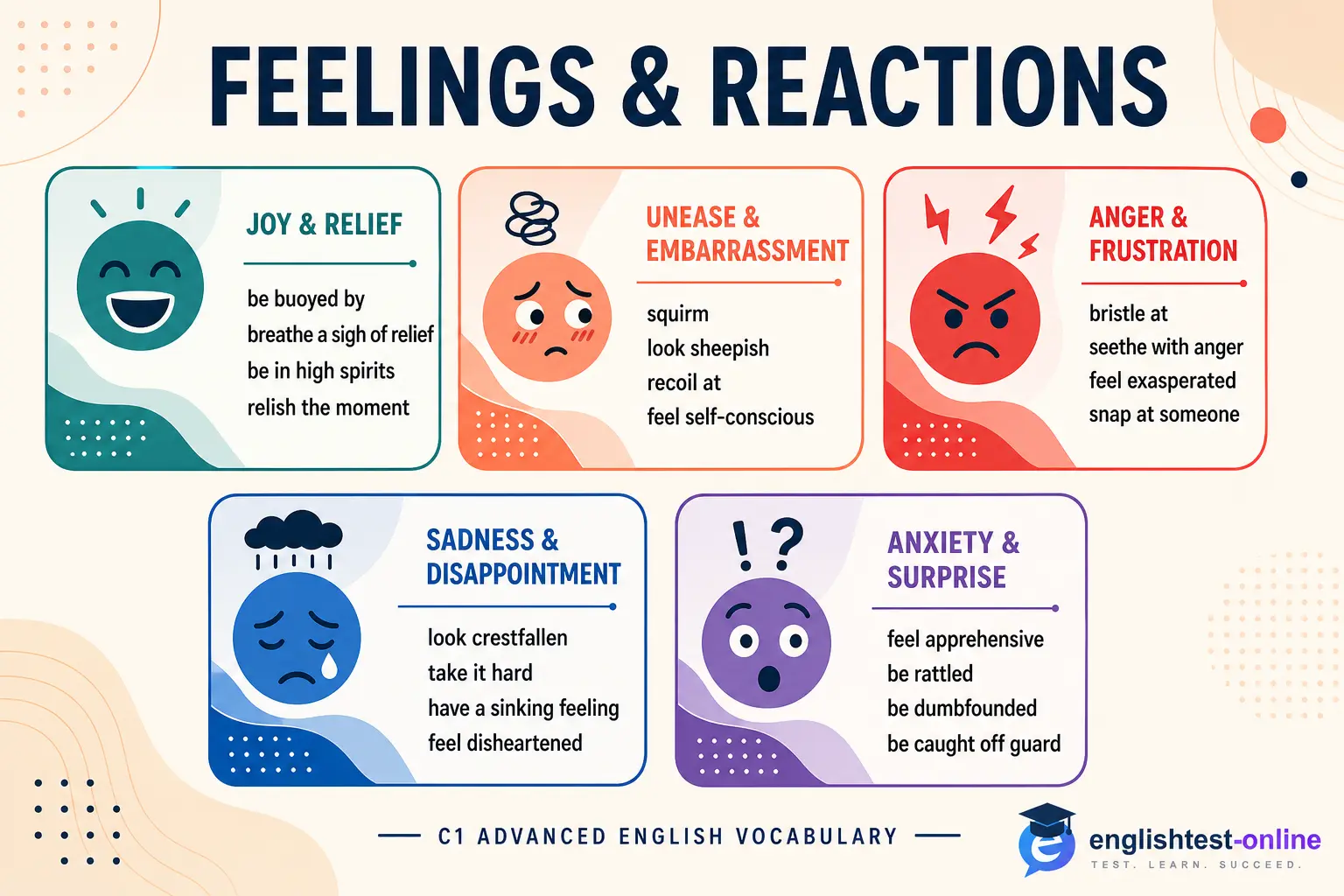
Joy and relief
Be buoyed by means to feel more cheerful or confident because of something encouraging.
The volunteers were buoyed by the unexpected wave of public support.
Breathe a sigh of relief means to relax visibly when a worry or danger has passed.
We breathed a sigh of relief when the missing documents were finally found.
Be in high spirits means to be lively, cheerful and optimistic.
The whole team was in high spirits after completing the project ahead of schedule.
Relish the moment means to take deliberate pleasure in an enjoyable or important experience.
Rather than checking her phone, Maya paused to relish the moment.
Unease and embarrassment
Squirm means to move or feel uncomfortable because a situation is embarrassing or unpleasant.
I squirmed as the presenter read my teenage diary entry aloud.
Look sheepish means to appear embarrassed because you know you have done something wrong or foolish.
Ben looked sheepish when we discovered who had eaten the last slice.
Recoil at means to react with sudden shock, disgust or strong dislike.
Several residents recoiled at the suggestion of demolishing the historic theatre.
Feel self-conscious means to worry excessively about how other people see you.
She felt self-conscious about speaking while everyone else was silent.
Anger and frustration
Bristle at means to react defensively or angrily to a remark or suggestion.
He bristled at the implication that his research was careless.
Seethe with anger means to feel intense anger while trying not to show it openly.
Priya sat quietly through the meeting, seething with anger.
Feel exasperated means to be extremely annoyed because a problem keeps happening.
The technician felt exasperated by the same avoidable error.
Snap at someone means to speak to someone suddenly and sharply, often because you are stressed.
I was exhausted and unfairly snapped at my colleague.
Sadness and disappointment
Look crestfallen means to look visibly disappointed or discouraged.
The finalists looked crestfallen when the event was cancelled.
Take it hard means to be deeply upset by criticism, loss or bad news.
He took the rejection hard, although he tried not to show it.
Have a sinking feeling means to experience the sudden sense that something is wrong or will go badly.
I had a sinking feeling when the train stopped between stations.
Feel disheartened means to lose confidence or hope after a setback.
Do not feel disheartened if your first proposal is unsuccessful.
Anxiety and surprise
Feel apprehensive means to feel worried about something that may happen in the future.
Many graduates feel apprehensive before their first professional interview.
Be rattled means to become nervous or confused after an unexpected difficulty.
The aggressive opening question rattled the usually confident speaker.
Be dumbfounded means to be so surprised that you do not know what to say.
We were dumbfounded by the judge's final decision.
Be caught off guard means to be surprised because you were not prepared for something.
The journalist's personal question caught the actor off guard.
Using these expressions naturally
Pay attention to grammar and register. Some items are adjective phrases (be rattled), some are verbs followed by a preposition (bristle at, recoil at), and others are fixed collocations (breathe a sigh of relief). Several describe visible reactions, while others focus on an internal emotional state. Choose the expression whose intensity and context match the situation rather than replacing every simple emotion with an idiom.
Comments (0)
Log in to join the discussion.