
Describing a Photo - B1+ English Writing — Explanation
How to Describe a Photo in English
A strong photo description helps the reader imagine both the visible scene and the atmosphere behind it. At B1+ level, you should move beyond listing objects. Organise details clearly, describe positions and actions, use precise adjectives and adverbs, and speculate carefully when the picture does not provide definite information.
Model Photo Description
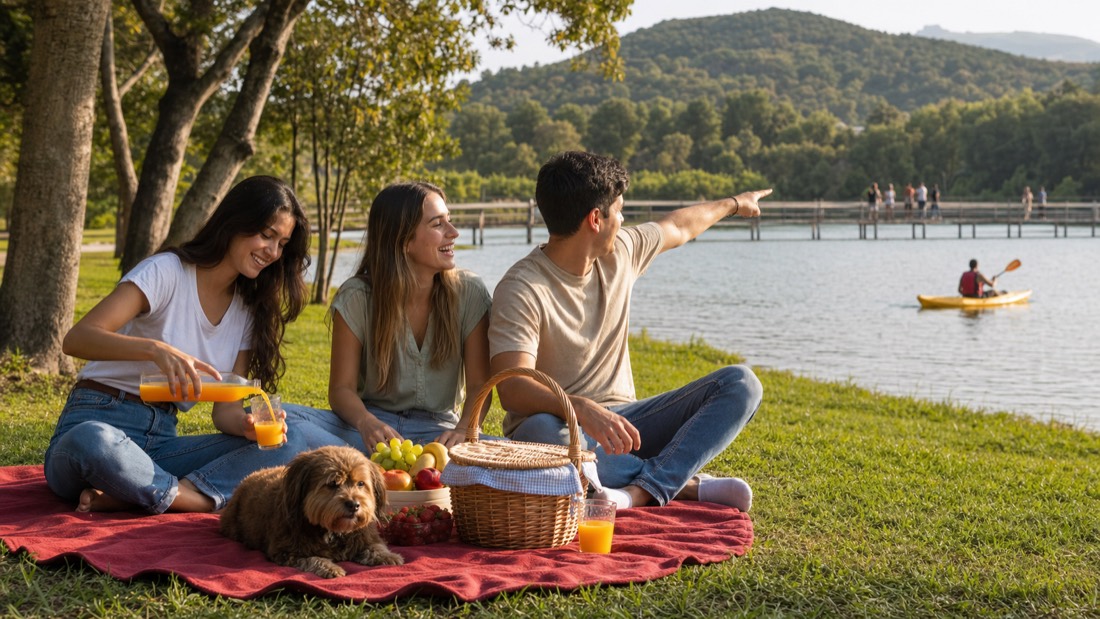
This photo portrays three friends enjoying a picnic beside a calm lake on a warm afternoon. The scene looks relaxed and cheerful, with green hills and trees surrounding the water.
In the foreground, a large round red blanket covers the grass. A wicker picnic basket, glasses of orange juice and colourful fruit have been placed on it. A small brown dog is lying quietly near the basket and appears to be watching the camera.
In the middle of the picture, the three friends are sitting close together. On the left, a young woman with long dark hair is carefully pouring juice. Next to her, another woman is laughing, while the man on the right is pointing enthusiastically towards the lake. They seem to have noticed something interesting on the water.
In the background, a person is paddling a bright yellow kayak across the lake. Behind the water, wooded hills rise into the distance, and several people are walking along a narrow footbridge. The soft sunlight suggests that the picture might have been taken in the late afternoon.
I like this photograph because it captures a simple moment of friendship. It looks as if the group has escaped from a busy week to spend time outdoors, and the peaceful setting makes the whole scene feel welcoming.
Organise Your Description
1. Give a general overview
Start by saying what the picture shows and identifying the setting or main activity. Useful openings include This picture shows..., The photo depicts..., The image portrays... and In this photograph, we can see.... Mention the overall atmosphere if it is clear.
2. Move through the picture logically
Choose a route that readers can follow: foreground to background, left to right, or main subject to smaller details. Use in the foreground, in the middle, in the background, on the left/right, at the top/bottom and in the corner.
3. Describe people, objects and actions
Explain appearance, clothing, position and activity. The present continuous is useful for visible actions: A woman is pouring juice. Use there is/are for objects and people: There are several walkers on the bridge.
4. Speculate about unclear details
A photograph rarely explains relationships, reasons or feelings directly. Use might, could, must, can't, seem, appear and look as if to separate observation from interpretation.
5. Add a personal response
Finish by explaining why the image interests you or how it makes you feel. Connect your reaction to specific visual evidence rather than writing a general sentence such as I like it because it is nice.
Adjectives and Adjective Order
Adjectives make objects easier to visualise. When several adjectives appear before a noun, English normally follows this order: opinion, size, age, shape, colour, origin and material. For example: a charming small old stone cottage or a beautiful round red picnic blanket. Use only the details that matter; too many adjectives can make a sentence heavy.
Position and Movement
Use next to, between, behind, in front of, near, opposite and beside to locate people and objects. For movement, use towards, away from, across, along, over, through and into: A cyclist is moving across the square.
Adverbs of Manner
Adverbs explain how an action happens: quietly, carefully, enthusiastically, slowly and happily. They usually follow the verb phrase: The dog is lying quietly beside the basket. Place an adverb before the main verb only when you want special emphasis.
Language for Speculation
- Must: strong logical certainty — They must be friends because they look very relaxed together.
- Might/Could: possibility — They might be celebrating something.
- Can't: strong negative certainty — It can't be winter because everyone is wearing light clothes.
- Seem/Appear + to-infinitive: The vendor appears to be arranging fruit.
- Look + adjective: The market looks busy.
- Look as if + clause: It looks as if the cyclist is in a hurry.
Common Mistakes
- Do not invent facts as if they were certain; signal guesses with speculative language.
- Do not jump randomly between different areas of the picture.
- Do not confuse in the foreground with at the front of an object.
- Do not write appears that be; use appears to be or it appears that...
- Do not use an adjective where an adverb is needed: walking slowly, not walking slow.
- Do not forget a final interpretation or personal reaction when the task requests one.
Final Checklist
Check that your description begins with an overview, follows a clear visual order and includes specific details about people, objects and actions. Make sure position phrases are accurate, adjective order is natural, and guesses are marked with modal verbs or sense verbs. End with a relevant personal reflection and proofread articles, prepositions and verb forms.
Comments (0)
Log in to join the discussion.