

Practice defining and non-defining relative clauses with B1 grammar exercises. Clear explanations and test-style questions for learners.
Defining and Non-Defining Relative Clauses Exercises
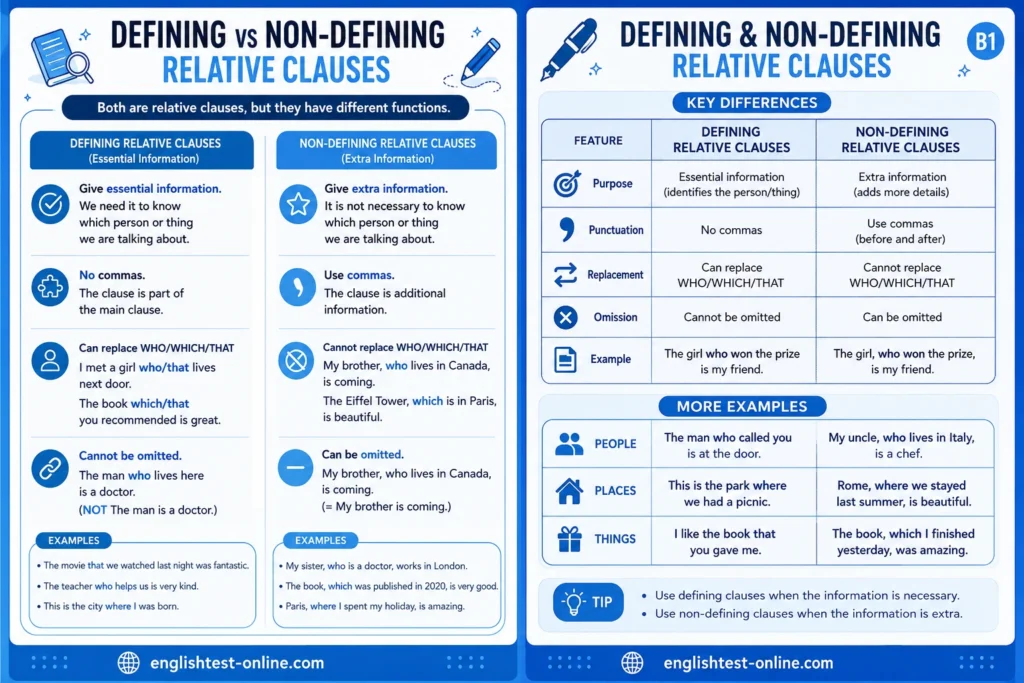
In English, relative clauses add more information to a noun. At the B1 level, it’s important to know the difference between defining and non-defining relative clauses. They have different meanings, punctuation, and grammar rules.
What Is a Relative Clause?
A relative clause is a part of a sentence that starts with a word like who, which, that, whose, where, or when.
Example
- The woman who lives next door is a doctor.
The clause tells us more about the woman.
Defining Relative Clauses
Relative clauses that define things give important information. They tell us who or what we are talking about. The sentence wouldn’t make sense without this information.
Important Features
- No commas
- The information is needed
- We can use “who,” “which,” “that,” “whose,” “where,” and “when.”
Examples
- The book that I bought yesterday is very interesting.
- The students who arrived late missed the test.
- This is the house where I grew up.
That is very common when defining relative clauses.
Non-Defining Relative Clauses
Relative clauses that don’t define give more information. You can take this information out without changing the main point.
Important Features
- Use of commas
- The extra information is
- That is not something we use.
Examples
- My brother, who lives in London, is visiting us.
- This laptop, which I bought last year, works perfectly.
- Turkey, where I live, is a beautiful country.
The sentence is still clear without the relative clause.
Comparison of Defining and Non-Defining
| Defining | Non-Defining |
|---|---|
| No commas | Uses commas |
| Essential information | Extra information |
| That is possible | That is not used |
Example Pair
- Students who study regularly get better results.
- My students, who study regularly, get better results.
The meaning changes based on the kind of clause.
Relative Pronouns for B1 Level
- who – people
- which – things
- that – people or things (defining only)
- whose – possession
- where – places
- when – time
Things You Shouldn’t Do
Incorrect: My sister that lives in Paris is a teacher.
Correct: My sister, who lives in Paris, is a teacher.
Incorrect: The car, that I bought yesterday, is new.
Correct: The car that I bought yesterday is new.
Before choosing the type of clause, make sure the information is necessary.
Important Things to Keep in Mind
- Use defining relative clauses to give important information.
- Use non-defining relative clauses to add more information.
- Only use commas with clauses that don’t define.
- In non-defining clauses, don’t use that.