
Basic word order in English — Explanation
Use simple A1 examples to learn the basic word order in English. Learn how to make clear, correct English sentences easily by understanding Subject + Verb + Object.
The basic order of words in English
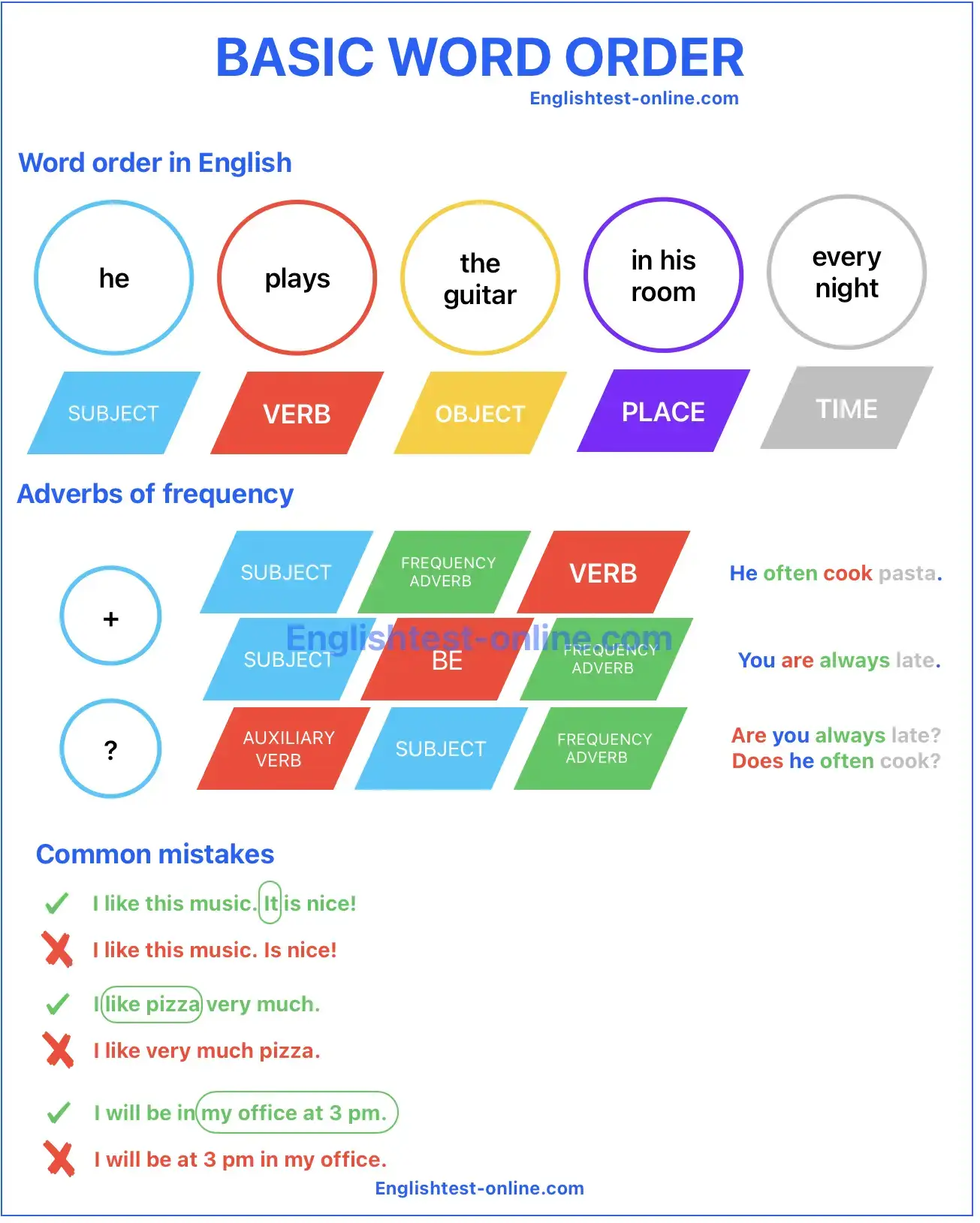
Subject + Verb + Object
This is what English calls the basic word order.
It tells us who does what and to whom.
Who is the subject?
The subject is the person or thing that does something.
Examples:
- I, You, He, She, We, They, The cat, My friend
Verb (What do you do?)
The verb tells what the subject does.
Examples:
- eat, go, read, play, watch, work
Object (What or whom?)
The object receives the action.
Examples:
- an apple, football, a book, TV, the piano
Example Sentences
| Sentence | Explanation |
|---|---|
| I eat an apple. | Subject = I → Verb = eat → Object = an apple |
| She plays football. | Subject = She → Verb = plays → Object = football |
| They watch TV. | Subject = They → Verb = watch → Object = TV |
Word Order with Adverbs of Time and Place
Adverbs (like "today," "at home," and "in the morning") usually come at the end of a sentence in English.
Examples:
- I eat breakfast in the morning.
- She works at school.
- They play football every day.
Structure:
Subject + Verb + Object + Adverb
Common Mistakes
Incorrect: Eat I apple.
Correct: I eat an apple.
Incorrect: Plays she football.
Correct: She plays football.
English word order is not flexible — changing the order can make the sentence wrong or confusing.
Tip for Beginners
If you remember this simple pattern, your sentences in English will be clear and correct:
Subject + Verb + Object + (Place) + (Time)
Example: I study English at home every evening.
Summary
| Element | Function | Example |
|---|---|---|
| Subject | Who does the action | I, You, He, She |
| Verb | What happens | eat, read, play |
| Object | What or whom | an apple, a book |
| Adverb (optional) | Where/When | at home, in the morning |
Comments (0)
Log in to join the discussion.