
Future forms: Will, be going to, present continuous — Explanation
Use will, going to, and present continuous exercises to practice B1 future forms. Use clear examples, answers, and explanations to help you get better at grammar.
Future Forms in English: Will, Be Going To, and Present Continuous Exercises
It's important to talk about the future in everyday English. Students at the B1 level need to know the differences between "will," "be going to," and the present continuous when talking about things that will happen in the future. Each form has a unique meaning and is used in different situations.
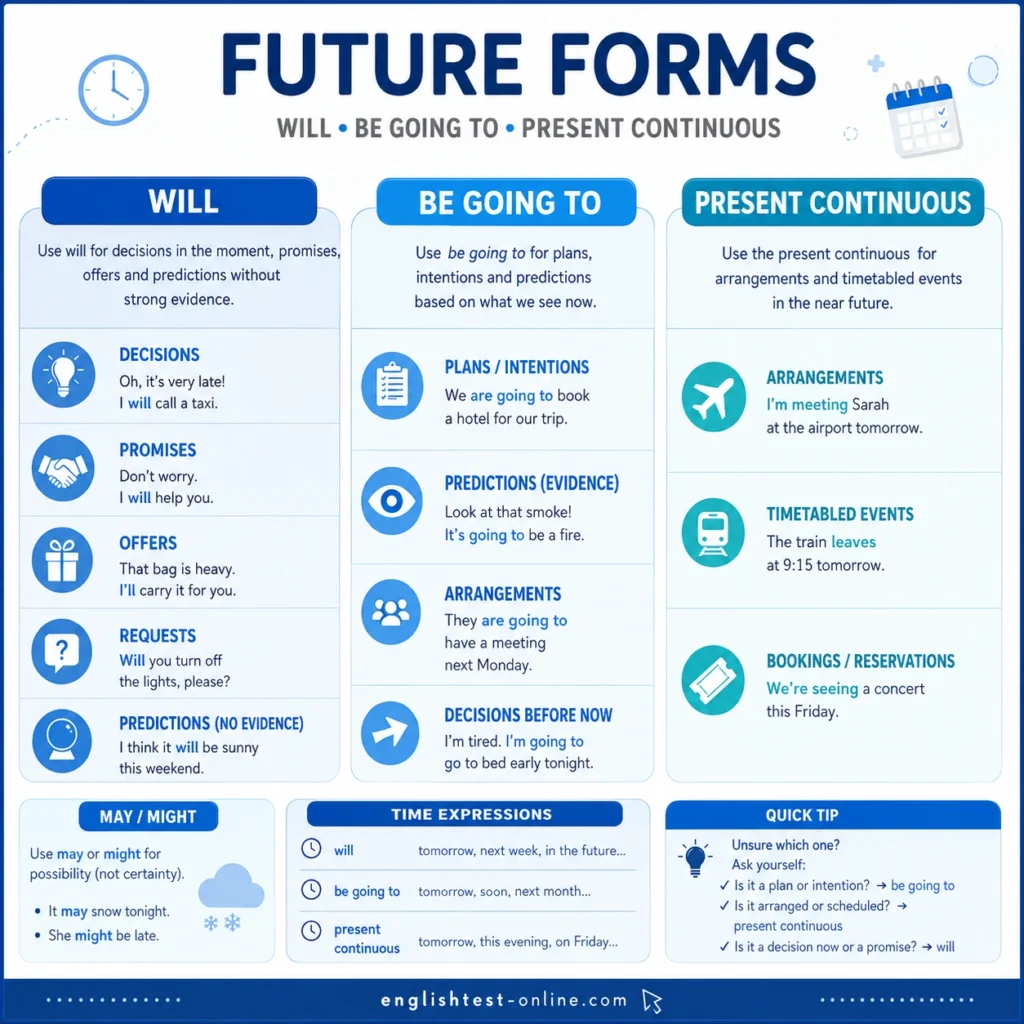
Using “Will” for Future Decisions, Predictions, and Promises
We use "will" to talk about things that will happen in the future, things that are decided while we are talking, and promises or offers.
Structure
Subject + will + base verb
Choices made while speaking
We use will when we make a decision right away.
Examples:
- I’m tired. I will go to bed early tonight.
- The phone is ringing. I will answer it.
- We don’t have milk. I will buy some.
In these cases, the choice is made while talking.
Predictions based on opinion
When we guess something based on what we think or believe, we use will.
Examples:
- I think it will rain tomorrow.
- She will probably pass the exam.
- This new phone will be very popular.
These predictions are not based on current evidence; they are just opinions.
Promises, offers, and requests
We often use will to make a promise or offer help.
Examples:
- I will help you with your homework.
- Don’t worry. I will call you later.
- Will you open the window, please?
Using “Be Going To” for Plans and Predictions with Evidence
We use "be going to" to talk about plans we've already made for the future and predictions based on what we know now.
Structure
Subject + be (am/is/are) + going to + base verb
Use 1: Plans and intentions
We say "going to" when we've already made up our minds to do something.
Examples:
- I am going to visit my grandparents this weekend.
- She is going to study medicine.
- They are going to move to a new house.
Before talking, the choice was made.
Use 2: Predictions based on present evidence
We use going to when we can see something that tells us what will happen.
Examples:
- Look at those clouds. It is going to rain.
- He is driving too fast. He is going to have an accident.
- The glass is full. It is going to fall.
These predictions are based on things we can see.
Using Present Continuous for Future Arrangements
When we know the time and place, we use the present continuous to talk about plans that are set in stone and will happen in the future.
Structure
Subject + am/is/are + verb-ing
Use: Fixed future arrangements
People often use this form for meetings, appointments, and personal plans.
Examples:
- I am meeting my friend tomorrow.
- She is starting a new job next week.
- We are flying to London on Monday.
- They are having dinner at 7 p.m.
These plans are already in place.
Key Differences Between Will, Going To, and Present Continuous
Understanding the differences helps you choose the correct form.
Going to vs. Will
- Use will for choices made now.
- When you make plans ahead of time, use "going to."
Examples:
- I will call her now. (decision made now)
- I am going to call her tonight. (plan already decided)
Going To vs Present Continuous
Both can talk about plans, but the present continuous is usually used for plans that are set in stone.
Examples:
- I am going to travel this summer. (general plan)
- I am traveling to Italy on June 10th. (fixed arrangement)
Will vs Present Continuous
- Use will to make predictions and decisions on the spot.
- Use present continuous for plans that are already set.
Examples:
- I think he will win the match. (prediction)
- He is playing the match tomorrow at 3 p.m. (arrangement)
Common Time Expressions Used with Future Forms
People often use these words to talk about the future:
- tomorrow
- tonight
- next week / next month / next year
- soon
- later
- in the future
- this weekend
- on Monday
- at 8 p.m.
Examples:
- I will see you tomorrow.
- She is going to start university next year.
- We are meeting them tonight.
Summary: When to Use Each Future Form
Use will for:
- choices made right now
- forecasts based on opinion
- offers and promises
Use "be going to" for:
- plans and goals that have already been made
- forecasts based on current proof
Use the present continuous for:
- set plans
- planned events in the future with a time and place
Comments (0)
Log in to join the discussion.