
Although vs However - Grammar Shorts — Explanation
Although and however are both used to show contrast, but they are not used in the same way. This is one of the most common grammar mistakes for English learners because these words have different grammatical functions. Understanding the difference will help you write and speak more naturally.
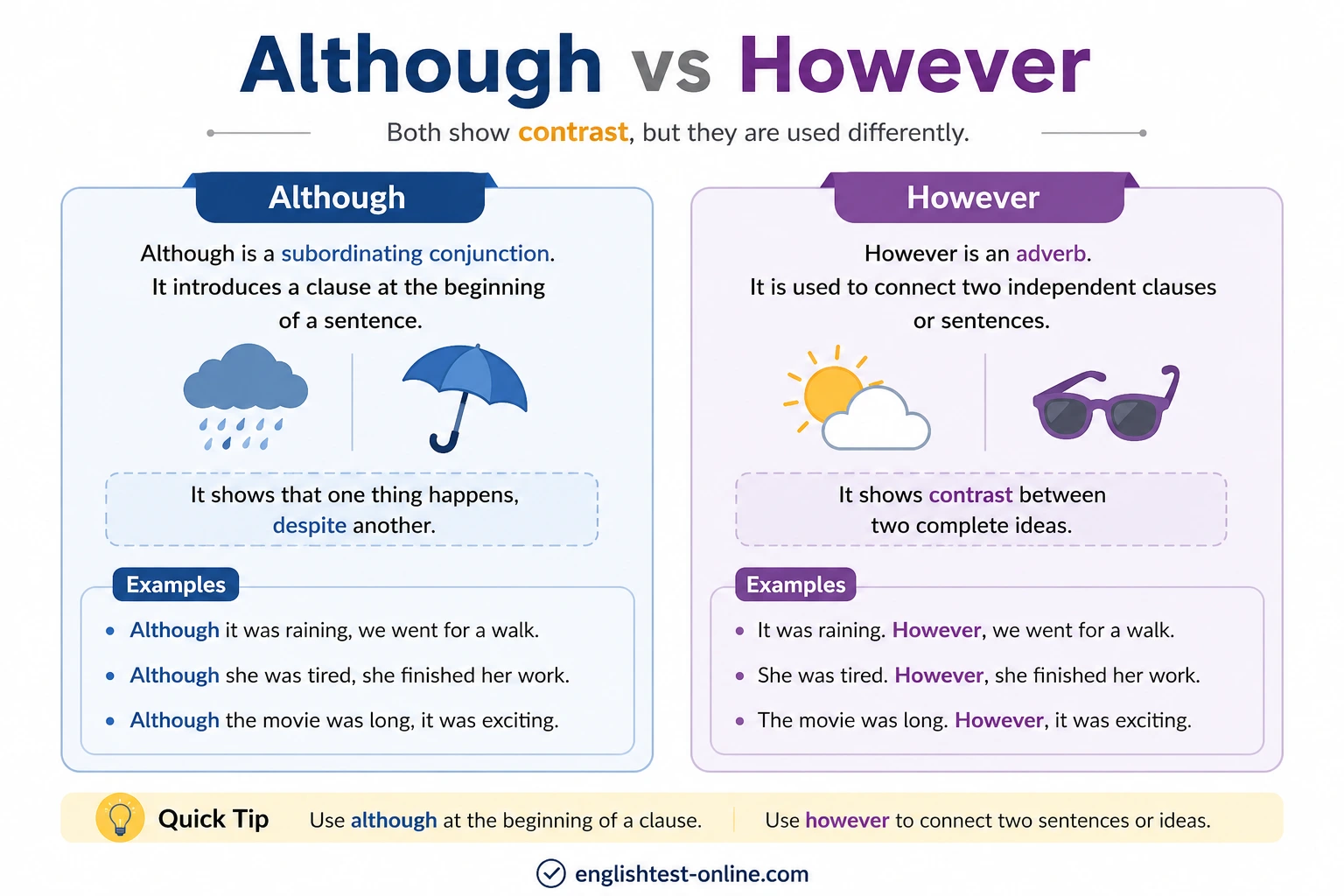
What Does "Although" Mean?
Although is a subordinating conjunction. It introduces a dependent clause and means despite the fact that.
You can use although at the beginning or in the middle of a sentence.
Structure
Although + clause, main clause.
Main clause + although + clause.
Examples
- Although it was raining, we went for a walk.
- Although she was tired, she finished her homework.
- Although the exam was difficult, everyone stayed calm.
- I enjoyed the movie although it was very long.
- Although he speaks quietly, everyone listens carefully.
What Does "However" Mean?
However is a conjunctive adverb. It connects two independent ideas and shows contrast between them.
Unlike although, however does not introduce a dependent clause. It is usually separated by punctuation such as a period, semicolon, or comma.
Common Structures
Sentence. However, sentence.

Sentence; however, sentence.
Examples
- It was raining. However, we went for a walk.
- She was tired. However, she finished her homework.
- The exam was difficult. However, everyone stayed calm.
- The hotel was expensive. However, the service was excellent.
- He studied hard. However, he didn't pass the test.
Key Differences Between Although and However
| Although | However |
|---|---|
| Subordinating conjunction | Conjunctive adverb |
| Introduces a dependent clause | Connects two complete ideas |
| No period before it in the same sentence | Usually follows a period or semicolon |
| Can appear at the beginning or middle of a sentence | Often appears at the beginning of the second sentence |
Compare the Difference
| Although | However |
|---|---|
| Although it was cold, we went outside. | It was cold. However, we went outside. |
| Although she was busy, she helped me. | She was busy. However, she helped me. |
| Although he missed the bus, he arrived on time. | He missed the bus. However, he arrived on time. |
| Although the task was difficult, they completed it. | The task was difficult. However, they completed it. |
Advertisement
Comments (0)
Log in to join the discussion.
Related lessons
Advertisement