
Instead and Instead of - Grammar Shorts — Explanation
Both instead and instead of express an alternative or a replacement, but they are used differently. instead is an adverb and is normally found at the end or beginning of a sentence. Instead of is a prepositional phrase and requires a noun, pronoun or -ing (gerund) after it.
Instead vs Instead of
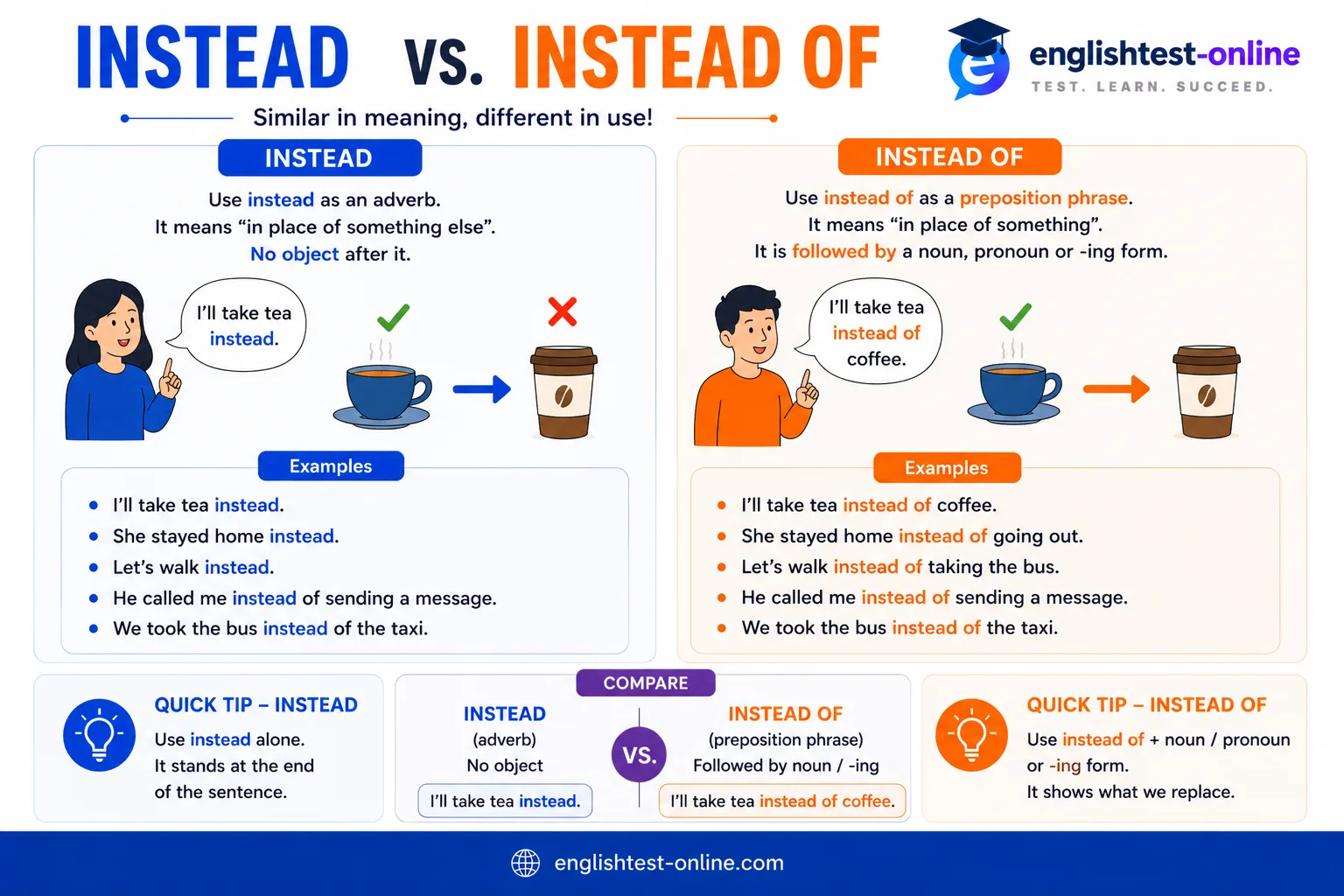
When to Use "Instead"
Use instead when you mention an alternative without directly following it with a noun or verb.
Structure
Sentence + instead
Instead, + sentence
Examples
- I was tired, so I stayed home instead.
- She didn't buy a dress. She bought a jacket instead.
- Let's walk instead.
- He decided to study instead.
- Instead, we ordered pizza.
When to Use "Instead of"
Use instead of before a noun, pronoun, or verb + -ing to show what is being replaced.
Structure
instead of + noun
instead of + pronoun
instead of + verb (-ing)
Examples
- I drank tea instead of coffee.
- She walked instead of taking the bus.
- We stayed home instead of going out.
- He chose fish instead of steak.
- Instead of watching TV, I read a book.
Key Differences
| Instead | Instead of |
|---|---|
| An adverb | A prepositional phrase |
| Usually comes at the beginning or end of a sentence | Must be followed by a noun, pronoun, or gerund |
| No object follows it | An object always follows it |
| I stayed home instead. | I stayed home instead of going out. |
Compare the Difference
| Instead | Instead of |
|---|---|
| Let's order pizza instead. | Let's order pizza instead of cooking. |
| She took a taxi instead. | She took a taxi instead of the bus. |
| I stayed home instead. | I stayed home instead of going to the party. |
| Instead, we watched a movie. | Instead of watching TV, we played cards. |
Both instead and instead of express an alternative. Use instead as an adverb when it stands alone, usually at the beginning or end of a sentence. Use instead of before a noun, pronoun, or verb + -ing to show what is replaced. Remember the simple rule: instead = alone, instead of = followed by something.
Comments (0)
Log in to join the discussion.