
Look vs Watch vs See - Grammar Shorts — Explanation
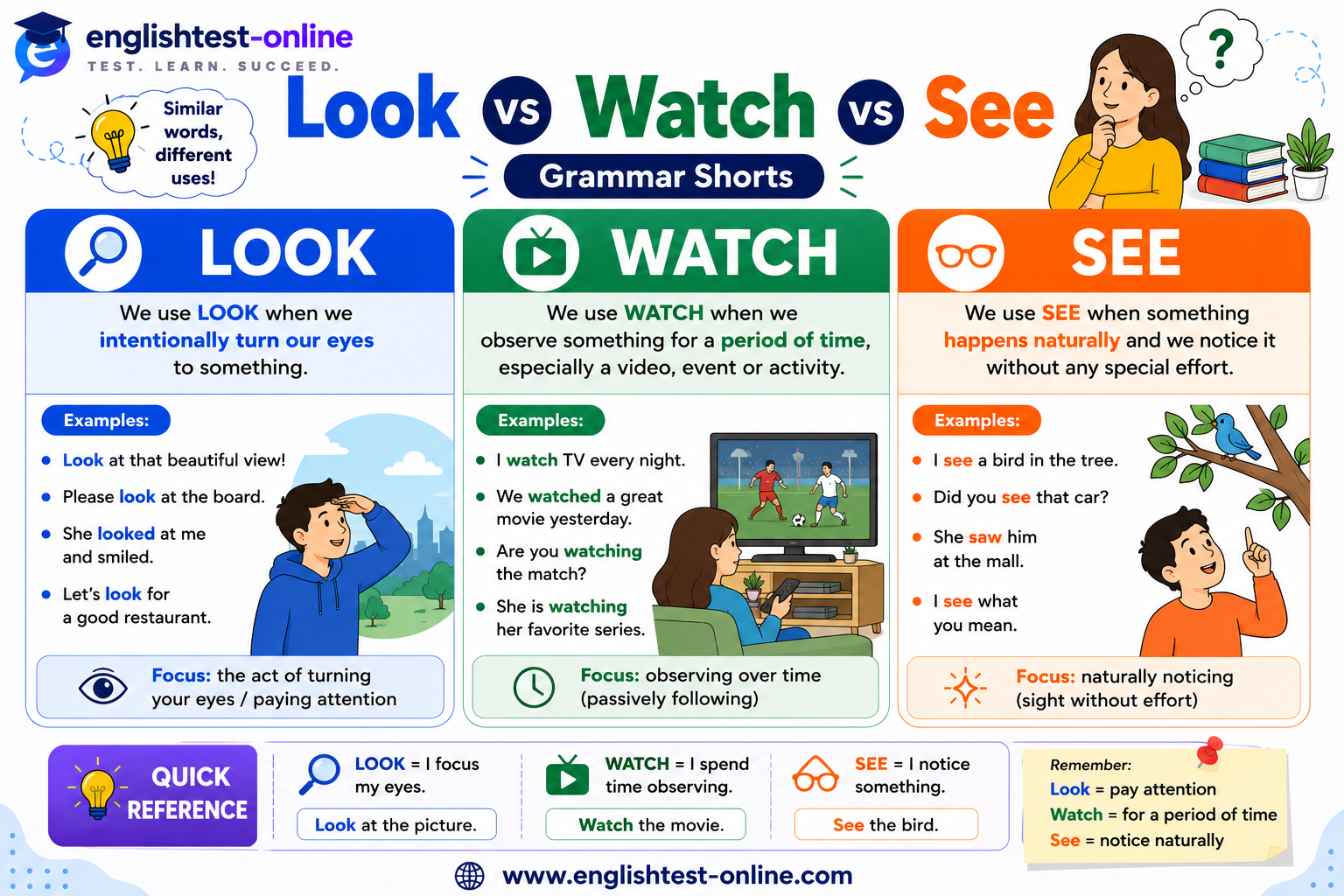
See - Meaning and Usage
Use see when something comes into your vision naturally or when you notice something without making a special effort. It is usually an unplanned action. Structure:see + object
Examples:
- I can see a bird in the tree.
- Did you see that accident?
- She saw her friend at the shopping mall.
Look - Meaning and Usage
Use look when you intentionally direct your eyes toward something. It is a deliberate action. We often use look at before an object.
Structure:
look at + object
Examples:
- Look at this beautiful painting.
- She is looking at the menu.
- Please look at the screen carefully.
Watch - Meaning and Usage
Use watch when you look at something for a period of time, especially something that moves or changes. It requires attention and concentration.
Structure:
watch + object
Examples:
- We watched a movie last night.
- They are watching a football match.
- She likes to watch birds in the garden.
Look vs Watch vs See Comparison
| Verb | Meaning | Example |
|---|---|---|
| Look | Direct your eyes intentionally | Look at the picture. |
| Watch | Look at something for a period of time | Watch a football game. |
| See | Notice something with your eyes | I see a car outside. |
Common Mistakes
Many learners use these verbs interchangeably. Remember that the type of visual action determines the correct verb.
Incorrect:
- I see at the picture.
- I look a movie every weekend.
Correct:
- I look at the picture.
- I watch a movie every weekend.
Special Uses
Some expressions use these verbs in common phrases:
- See a doctor: You should see a doctor if you feel sick.
- Look for: I am looking for my keys.
- Watch out: Watch out! There is a car coming.
Quick Tip
Ask yourself: "How am I using my eyes?"
- Notice something naturally → use see.
- Direct your eyes intentionally → use look (at).
- Follow something moving or happening → use watch.
Practice Look vs Watch vs See
Test your knowledge with our Look vs Watch vs See grammar exercises. Choose the correct answer and improve your English grammar accuracy with instant feedback.
Comments (0)
Log in to join the discussion.