

Practice A1 English writing exercises about describing your house. Learn simple vocabulary, sentence patterns, and easy examples.
Describe My House – A1 English Writing Exercises
Writing about your house is a great way to practice basic English skills. At A1 level you should be able to use short and simple sentences to describe where you live, the rooms in your house and the things in your rooms. When you write about your house, try to arrange your ideas so that your writing is easy to read. Beginner learners should be taught simple vocabulary and expressions used in everyday situations. Basic house descriptions typically include information about rooms, furniture, and location.
What to include in a house description?
When describing your home you may want to consider:
- What kind of home you live in (house, flat, apartment)
- Where you live
- Number of rooms
- What furniture or objects are in the rooms
- Your best room
- Additional areas such as garden, balcony or garage
Having a clear order makes writing easier. Start with general stuff, then describe each part of the house.
Words to describe a house useful to know
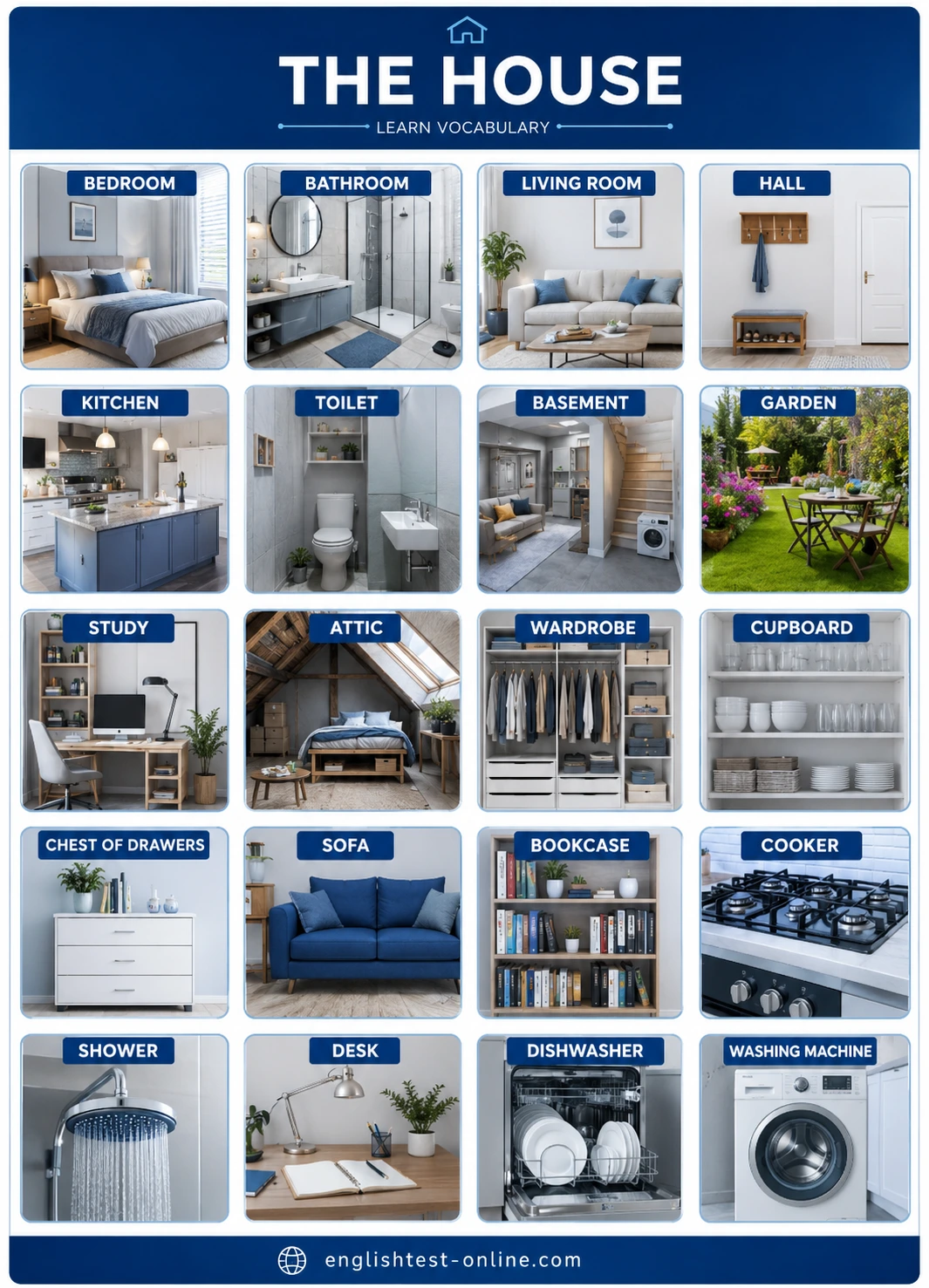
Some common words for A1 are:
Rooms
- bedroom
- bathroom
- kitchen
- living room
- dining room
- hall
- garden
- balcony
Furniture and objects
- bed
- sofa
- table
- chair
- wardrobe
- television
- desk
- fridge
- lamp
Some basic house vocabulary will help you to form natural sentences.
“There is” and “There are”
Such expressions are very useful to describe rooms and furniture.
There is one thing to use:
- There is a big sofa in the living room.
- There is a desk in my bedroom.
Use There are for more than one thing:
- There are two bedrooms in my house.
- There are three chairs in the kitchen.
For negative sentences:
- There isn’t a balcony.
- There aren’t any plants in my room.
These patterns are used widely in A1 home descriptions as they are easy to understand and simple.
Use prepositions of location
Prepositions tell us where things are.
Examples:
- The house is near the park.
- The kitchen is next to the living room.
- There is a garden behind the house.
- My desk is in front of the window.
These small words make your writing more detailed.
Use “has” and “has got”
You can also use has or has got to describe your home.
Examples:
- My apartment has two bedrooms.
- My house has got a small garden.
- It doesn’t have a garage.
- It hasn’t got a balcony.
This structure adds variety to your writing.
Useful linking words
Connect ideas with simple linking words:
- and
- but
- because
- also
Examples:
- My room is small, but it is comfortable.
- There is a sofa and a television in the living room.
- I like my bedroom because it is quiet.
Linking words make your text smoother and more natural.