

English Test Online - Grammar, Vocabulary & Level AssessmentEnglish Test Online - Grammar, Vocabulary & Level AssessmentEnglish Test Online - Grammar, Vocabulary & Level Assessment
  • Grammar
    • A1 – Elementary
    • A2 – Pre-intermediate
    • B1 – Intermediate
    • B1+ Upper-intermediate
    • B2 – Pre-advanced
    • C1 – Advanced
  • Vocabulary
    • A1 – Elementary
    • A2 – Pre-intermediate
    • B1 – Intermediate
    • B2 – Pre-advanced
  • Listening
    • A1 Listening Tests
  • Reading
    • A1 Reading Tests
  • Writing
    • A1 Writing Exercises
Search
  • Use of English
  • Exams
Reading: Defining and non-defining relative clauses
Sign In
Notification Show More
Font ResizerAa
English Test Online - Grammar, Vocabulary & Level AssessmentEnglish Test Online - Grammar, Vocabulary & Level Assessment
Font ResizerAa
  • Home
  • Grammar
  • Blog
Search
  • Grammar
  • Vocabulary
  • Reading
  • Listening
  • Writing
  • Use of English
  • Exams
  • Level Test
Have an existing account? Sign In
© 2026 englishtest-online.com. All rights reserved. Powered by Infoverse.
B1 Grammar lessons and exercises

Defining and non-defining relative clauses

English Test Online
Last updated: May 10, 2026 6:14 pm
English Test Online

Practice defining and non-defining relative clauses with B1 grammar exercises. Clear explanations and test-style questions for learners.

Exercises & Summary
  1. Defining and Non-Defining Relative Clauses Exercises
  2. Exercise 1
  3. Exercise 2
  4. Exercise 3

Defining and Non-Defining Relative Clauses Exercises

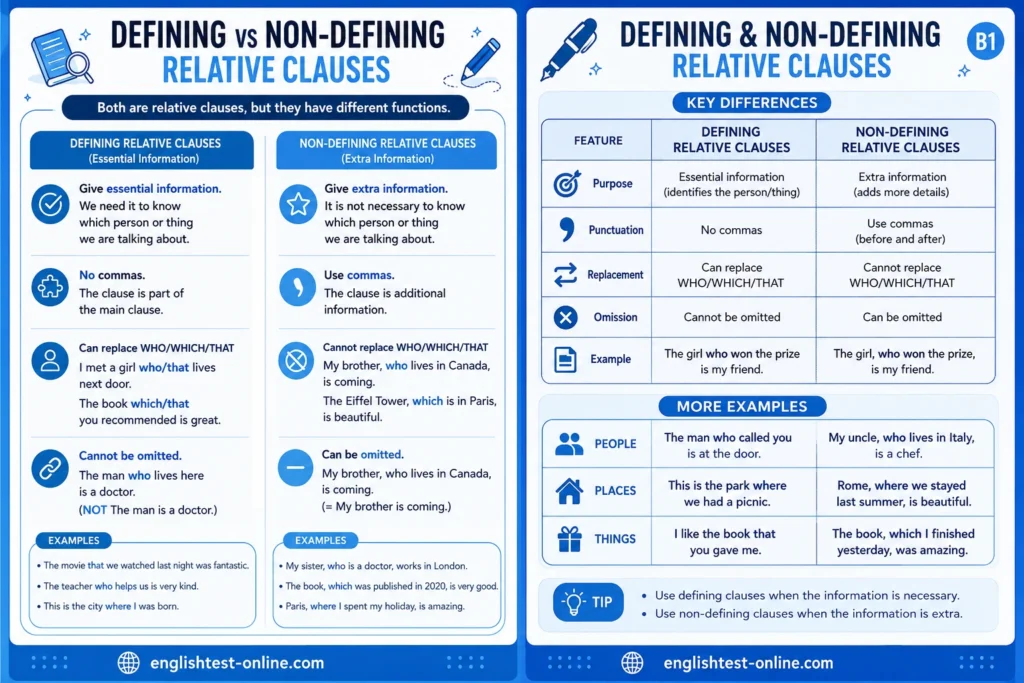
In English, relative clauses add more information to a noun. At the B1 level, it’s important to know the difference between defining and non-defining relative clauses. They have different meanings, punctuation, and grammar rules.
Defining and non-defining relative clauses

What Is a Relative Clause?

A relative clause is a part of a sentence that starts with a word like who, which, that, whose, where, or when.

Example

  • The woman who lives next door is a doctor.

The clause tells us more about the woman.

Defining Relative Clauses

Relative clauses that define things give important information. They tell us who or what we are talking about. The sentence wouldn’t make sense without this information.

Important Features

  • No commas
  • The information is needed
  • We can use “who,” “which,” “that,” “whose,” “where,” and “when.”

Examples

  • The book that I bought yesterday is very interesting.
  • The students who arrived late missed the test.
  • This is the house where I grew up.

That is very common when defining relative clauses.

Non-Defining Relative Clauses

Relative clauses that don’t define give more information. You can take this information out without changing the main point.

Important Features

  • Use of commas
  • The extra information is
  • That is not something we use.

Examples

  • My brother, who lives in London, is visiting us.
  • This laptop, which I bought last year, works perfectly.
  • Turkey, where I live, is a beautiful country.

The sentence is still clear without the relative clause.

Comparison of Defining and Non-Defining

DefiningNon-Defining
No commasUses commas
Essential informationExtra information
That is possibleThat is not used

Example Pair

  • Students who study regularly get better results.
  • My students, who study regularly, get better results.

The meaning changes based on the kind of clause.

Relative Pronouns for B1 Level

  • who – people
  • which – things
  • that – people or things (defining only)
  • whose – possession
  • where – places
  • when – time

Things You Shouldn’t Do

Incorrect: My sister that lives in Paris is a teacher.
Correct: My sister, who lives in Paris, is a teacher. Incorrect: The car, that I bought yesterday, is new.
Correct: The car that I bought yesterday is new.

Before choosing the type of clause, make sure the information is necessary.

Important Things to Keep in Mind

  • Use defining relative clauses to give important information.
  • Use non-defining relative clauses to add more information.
  • Only use commas with clauses that don’t define.
  • In non-defining clauses, don’t use that.
1234Next Test
Previous Test -Ed and -Ing Adjectives Exercises -Ed/-ing adjectives: Adjectives from verbs
Next Test Compound adjectives Compound adjectives with numbers: ‘A two-day trip’

Popular Tests

Future forms: Will, be going to, present continuous
B1 Grammar lessons and exercises

Future forms: Will, be going to, present continuous

May 10, 2026
Much, many, a lot of, a little, a few - English Test Grammar
A1 Grammar Lessons and Exercises

Much, many, a lot of, a little, a few

May 10, 2026
Past Simple vs Past Continuous - English Test A2
A2 Grammar lessons and exercises

Past Simple vs Past Continuous

May 10, 2026
Present Simple - English Test Grammar
A1 Grammar Lessons and Exercises

Present Simple: I do, I don’t, and I do

April 13, 2026
English Test Online - Grammar, Vocabulary & Level Assessment Free English Tests - Grammar, Vocabulary & Level Assessment

You can write us any mistakes or read our about page or see our privacy policy.

Levels

  • A1 – Elementary
  • A2 – Pre-Intermediate
  • B1 – Intermediate
  • B2 – Pre-Advanced

Info

  • Home
  • Privacy Policy
  • Cookie Policy
  • Terms and Conditions
  • Level Test
Take a level test
© 2026 Englishtest-online.com. All Rights Reserved.
  • Contact us
  • About us
  • Sitemap
  • Youtube
  • X
Manage Consent
To provide the best experiences, we use technologies like cookies to store and/or access device information. Consenting to these technologies will allow us to process data such as browsing behavior or unique IDs on this site. Not consenting or withdrawing consent, may adversely affect certain features and functions.
Functional Always active
The technical storage or access is strictly necessary for the legitimate purpose of enabling the use of a specific service explicitly requested by the subscriber or user, or for the sole purpose of carrying out the transmission of a communication over an electronic communications network.
Preferences
The technical storage or access is necessary for the legitimate purpose of storing preferences that are not requested by the subscriber or user.
Statistics
The technical storage or access that is used exclusively for statistical purposes. The technical storage or access that is used exclusively for anonymous statistical purposes. Without a subpoena, voluntary compliance on the part of your Internet Service Provider, or additional records from a third party, information stored or retrieved for this purpose alone cannot usually be used to identify you.
Marketing
The technical storage or access is required to create user profiles to send advertising, or to track the user on a website or across several websites for similar marketing purposes.
  • Manage options
  • Manage services
  • Manage {vendor_count} vendors
  • Read more about these purposes
View preferences
  • {title}
  • {title}
  • {title}