

English Test Online - Grammar, Vocabulary & Level AssessmentEnglish Test Online - Grammar, Vocabulary & Level AssessmentEnglish Test Online - Grammar, Vocabulary & Level Assessment
  • Grammar
    • A1 – Elementary
    • A2 – Pre-intermediate
    • B1 – Intermediate
    • B1+ Upper-intermediate
    • B2 – Pre-advanced
  • Vocabulary
    • A1 – Elementary
    • A2 – Pre-intermediate
    • B1 – Intermediate
    • B2 – Pre-advanced
  • Listening
    • A1 Listening Tests
  • Reading
    • A1 Reading Tests
  • Writing
Search
  • Use of English
  • Exams
Reading: Future in the past
Sign In
Notification Show More
Font ResizerAa
English Test Online - Grammar, Vocabulary & Level AssessmentEnglish Test Online - Grammar, Vocabulary & Level Assessment
Font ResizerAa
  • Home
  • Grammar
  • Blog
Search
  • Grammar
  • Vocabulary
  • Reading
  • Listening
  • Writing
  • Use of English
  • Exams
  • Level Test
Have an existing account? Sign In
© 2026 englishtest-online.com. All rights reserved. Powered by Infoverse.
B2 Grammar lessons and exercises

Future in the past

English Test Online
Last updated: May 6, 2026 6:47 am
English Test Online

Practice Future in the Past with B2 exercises. Clear explanations and test questions on structures like was going to, would and past predictions.

Exercises & Summary
  1. Future in the Past Exercises
  2. Exercise 1
  3. Exercise 1
  4. Exercise 2
  5. Exercise 3
  6. Exercise 3

Future in the Past Exercises

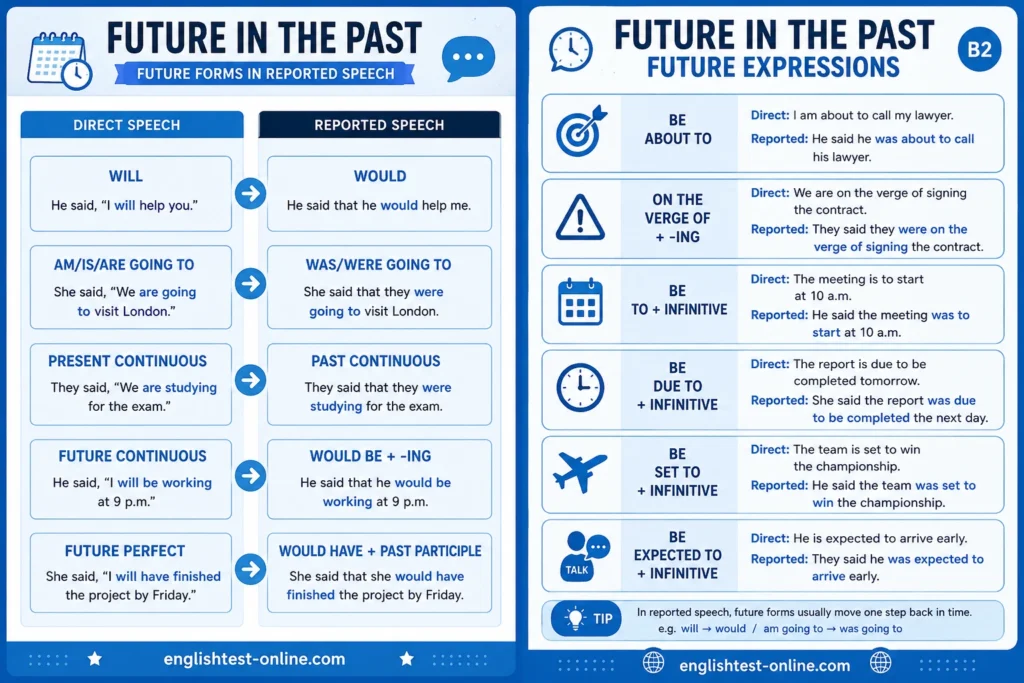
Future in the past When we talk about the future in the past, we are talking about actions or events that were in the future at a certain point in the past. In other words, we look back at some past situation and talk about what somebody thought, planned, expected or predicted would happen next.

The structure is very common in storytelling, in reported speech, and in everyday communication.

What is “Future in the Past”?

“Future in the past” refers to a future action viewed from the past perspective.

Example:

  • She said she would call me later.
    At the time she spoke (in the past), the call was in the future.

Standard Structures

Would

We use would as the past tense of will, especially in reported speech.

  • He said he would arrive at 8 p.m.
  • I knew they would help us.

To be used in:

  • Predictions in the past
  • Promises
  • Reported speech

Was/Were Going To

This form is for plans or intentions in the past.

  • I was going to start a new job, but I changed my mind.
  • They were going to travel, but the trip was canceled.

Use it for:

  • Plans that may or may not have happened
  • Intentions in the past

Was/Were About To

The structure indicated that something was about to happen soon.

  • She was about to leave when the phone rang.
  • We were about to order when they arrived.

Use it for:

  • Immediate future in the past

Was/Were Supposed To

We use this to talk about expectations or obligations in the past (often unfulfilled).

  • I was supposed to meet him, but I forgot.
  • They were supposed to finish the project yesterday.

Often implies:

  • Something didn’t happen as planned

Differences at a Glance

  • Would → neutral future from the past (predictions, promises)
  • Was going to → plans or intentions
  • Was about to → ‘nearly’ happened
  • Was supposed to → was expected or obligated to (but didn’t)

Future in the Past in Reported Speech

Normally we change the tense back when we report what someone said.

Direct speech:

  • “I will call you.”

Reported speech:

  • He said he would call me.

Mastering future in the past helps you sound more natural when you tell stories, report conversations, and describe past expectations. At B2 level, it’s important to be accurate and aware of context, so practice different structures and see how they are used in real life.


1234Next Test
Previous Test Reduced infinitives: Omitting the infinitive phrase after ‘to’ Reduced infinitives: Omitting the infinitive phrase after ‘to’

Popular Tests

Future forms: Will, be going to, present continuous
B1 Grammar lessons and exercises

Future forms: Will, be going to, present continuous

April 21, 2026
Much, many, a lot of, a little, a few - English Test Grammar
A1 Grammar Lessons and Exercises

Much, many, a lot of, a little, a few

April 27, 2026
Past Simple vs Past Continuous - English Test A2
A2 Grammar lessons and exercises

Past Simple vs Past Continuous

April 13, 2026
Defining and non-defining relative clauses
B1 Grammar lessons and exercises

Defining and non-defining relative clauses

April 13, 2026
English Test Online - Grammar, Vocabulary & Level Assessment Free English Tests - Grammar, Vocabulary & Level Assessment

You can write us any mistakes or read our about page or see our privacy policy.

Levels

  • A1 – Elementary
  • A2 – Pre-Intermediate
  • B1 – Intermediate
  • B2 – Pre-Advanced

Info

  • Home
  • Privacy Policy
  • Cookie Policy
  • Terms and Conditions
  • Level Test
Take a level test
© 2026 Englishtest-online.com. All Rights Reserved.
  • Contact us
  • Sitemap
  • Youtube
  • X
Manage Consent
To provide the best experiences, we use technologies like cookies to store and/or access device information. Consenting to these technologies will allow us to process data such as browsing behavior or unique IDs on this site. Not consenting or withdrawing consent, may adversely affect certain features and functions.
Functional Always active
The technical storage or access is strictly necessary for the legitimate purpose of enabling the use of a specific service explicitly requested by the subscriber or user, or for the sole purpose of carrying out the transmission of a communication over an electronic communications network.
Preferences
The technical storage or access is necessary for the legitimate purpose of storing preferences that are not requested by the subscriber or user.
Statistics
The technical storage or access that is used exclusively for statistical purposes. The technical storage or access that is used exclusively for anonymous statistical purposes. Without a subpoena, voluntary compliance on the part of your Internet Service Provider, or additional records from a third party, information stored or retrieved for this purpose alone cannot usually be used to identify you.
Marketing
The technical storage or access is required to create user profiles to send advertising, or to track the user on a website or across several websites for similar marketing purposes.
  • Manage options
  • Manage services
  • Manage {vendor_count} vendors
  • Read more about these purposes
View preferences
  • {title}
  • {title}
  • {title}