


Practice A1 English writing with daily routine exercises. Improve vocabulary, sentence building, and simple writing skills for beginners.
Writing about my daily routine A1 English Writing Explanation
The most effective way to write about your daily routine in English is to use simple and clear sentences. This is a very common topic for A1 English writing because it helps students to practice the present simple tense, time expressions and everyday vocabulary. A daily routine text usually talks about the things you do everyday, from morning to evening.
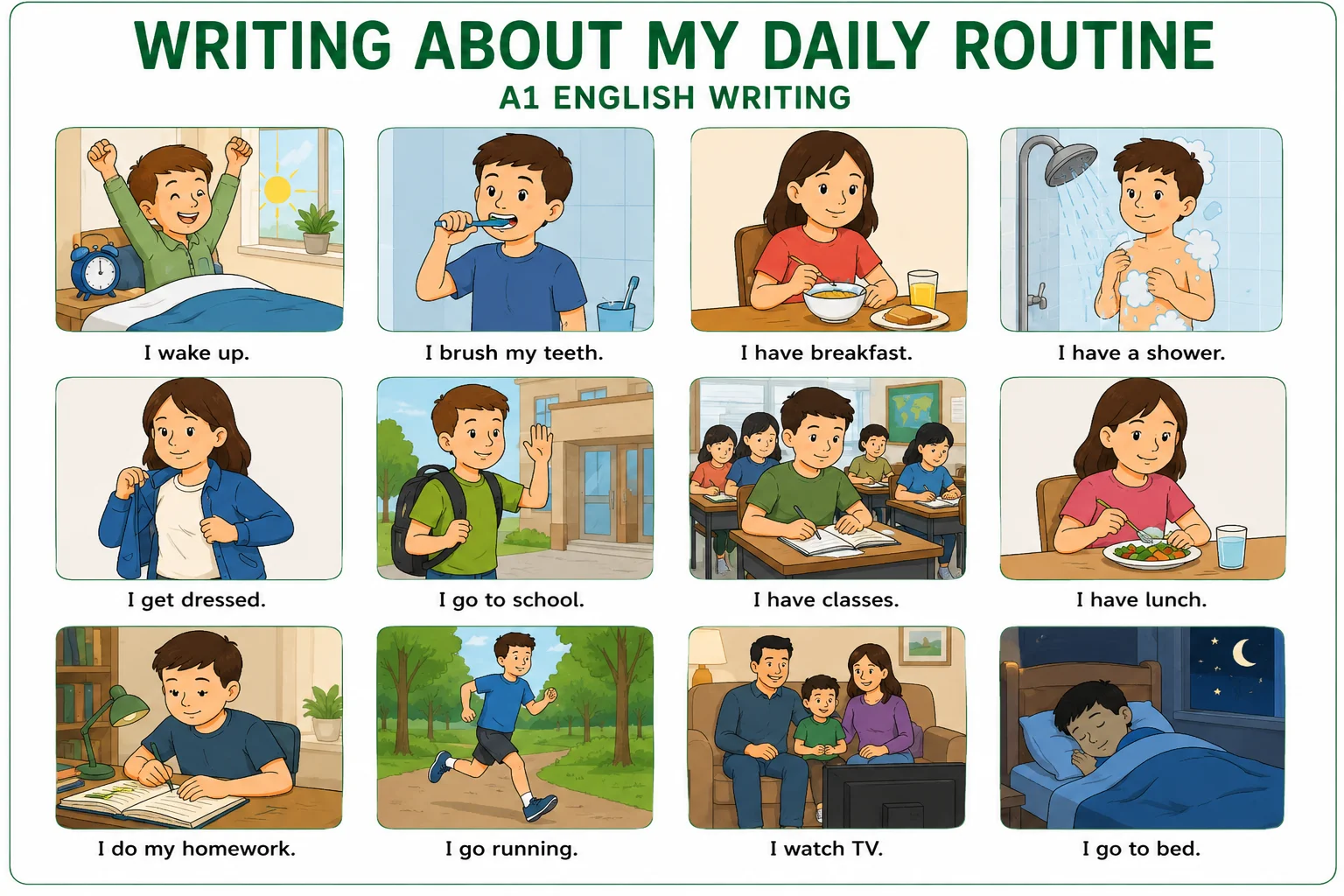
We generally use the present simple when we write about routines because we are talking about habits and repeated actions.
For example:
- I wake up at 7 o’clock.
- I brush my teeth and take a shower.
- I go to school by bus.
- I do my homework in the evening.
A good starting point is to think about what you do on a daily basis. You can make a little list before you start writing.
Normal everyday living activities:
- wake up
- get up
- brush my teeth
- wash my face
- have breakfast
- go to school
- study English
- have lunch
- go home
- do homework
- watch TV
- go to bed
Once you have selected your activities, try to link your ideas together in a natural way. Beginners often write very short sentences one after another, but using connectors makes the text flow better and easier to read.
Good connectors and time phrases:
- first
- then
- after that
- next
- in the morning
- in the afternoon
- in the evening
- before dinner
- after school
- finally
Example:
- I wake up at 6:30. I have breakfast. I go to school.
- This sounds very basic.
There is a better one:
- I wake up at 6:30 and then I have breakfast. After that, I go to school.
- Adverbs of frequency also make your writing more interesting. These words tell us how often we do something.
Adverbs of frequency:
- always
- usually
- often
- sometimes
- never
Examples:
- I usually drink coffee in the morning.
- I sometimes play video games after school.
- I never go to bed late on weekdays.
Breaking up your writing into small paragraphs is also a good idea. This is cleaner and easier to understand.”
A basic structure could be:
- Morning routine
- Afternoon activities
- Evening routine
Here is a simple example of a paragraph about daily routine in A1:
I usually wake up at 7:00 in the morning. First, I brush my teeth and wash my face. Then, I have breakfast with my family. After breakfast, I go to school by bus. In the afternoon, I come home and do my homework. In the evening, I watch TV or listen to music. Finally, I go to bed at 10:00.
Keep in mind these important grammar tips:
- Use the present simple tense for routines.
- Use “go home” NOT “go to home”.
- Use “have breakfast/lunch/dinner”.
- Use “at” for clock times: at 8:00.
- Use “in” for parts of the day: in the morning.
The more you write about your day-to-day life, the easier it gets to write in English. Even short paragraphs can help improve your vocabulary, grammar, and sentence structure.






Are you in fact visiting this site regularly, if so
then you will absolutely take fastidious experience.