

English Test Online - Grammar, Vocabulary & Level AssessmentEnglish Test Online - Grammar, Vocabulary & Level AssessmentEnglish Test Online - Grammar, Vocabulary & Level Assessment
  • Grammar
    • A1 – Elementary
    • A2 – Pre-intermediate
    • B1 – Intermediate
    • B1+ Upper-intermediate
    • B2 – Pre-advanced
    • C1 – Advanced
  • Vocabulary
    • A1 – Elementary
    • A2 – Pre-intermediate
    • B1 – Intermediate
    • B2 – Pre-advanced
  • Listening
    • A1 Listening Tests
  • Reading
    • A1 Reading Tests
  • Writing
    • A1 Writing Exercises
Search
  • Use of English
  • Exams
Reading: Writing about my daily routine – A1 English writing
Sign In
Notification Show More
Font ResizerAa
English Test Online - Grammar, Vocabulary & Level AssessmentEnglish Test Online - Grammar, Vocabulary & Level Assessment
Font ResizerAa
  • Home
  • Grammar
  • Blog
Search
  • Grammar
  • Vocabulary
  • Reading
  • Listening
  • Writing
  • Use of English
  • Exams
  • Level Test
Have an existing account? Sign In
© 2026 englishtest-online.com. All rights reserved. Powered by Infoverse.
A1 Writing Exercises and Tests

Writing about my daily routine – A1 English writing

English Test Online
Last updated: May 12, 2026 1:00 pm
English Test Online

Practice A1 English writing with daily routine exercises. Improve vocabulary, sentence building, and simple writing skills for beginners.

Exercises & Summary
  1. Writing about my daily routine A1 English Writing Explanation
  2. Exercise 1
  3. Exercise 2
  4. Exercise 3

Writing about my daily routine A1 English Writing Explanation

The most effective way to write about your daily routine in English is to use simple and clear sentences. This is a very common topic for A1 English writing because it helps students to practice the present simple tense, time expressions and everyday vocabulary. A daily routine text usually talks about the things you do everyday, from morning to evening.
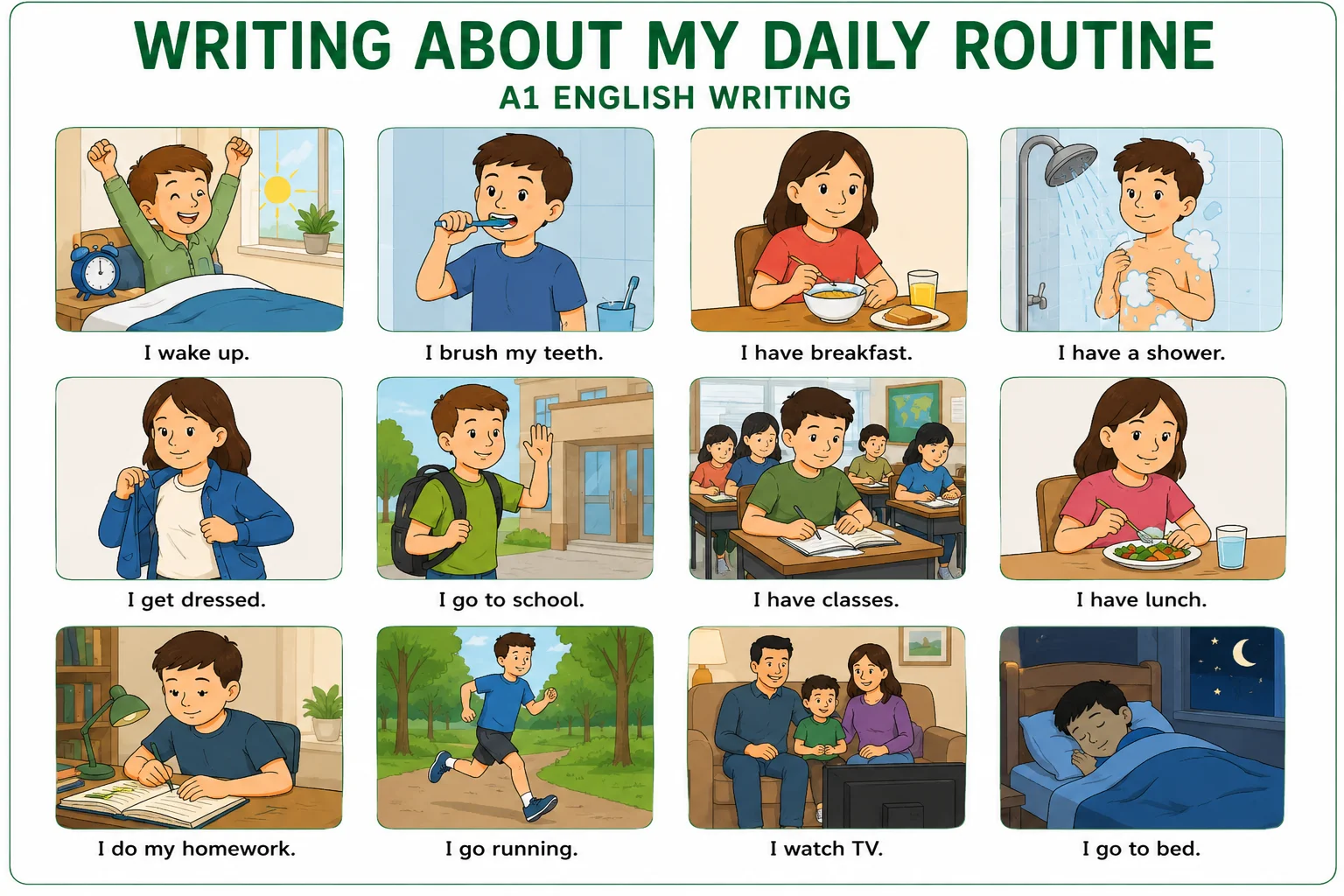
We generally use the present simple when we write about routines because we are talking about habits and repeated actions.

For example:

  • I wake up at 7 o’clock.
  • I brush my teeth and take a shower.
  • I go to school by bus.
  • I do my homework in the evening.

A good starting point is to think about what you do on a daily basis. You can make a little list before you start writing.

Normal everyday living activities:

  • wake up
  • get up
  • brush my teeth
  • wash my face
  • have breakfast
  • go to school
  • study English
  • have lunch
  • go home
  • do homework
  • watch TV
  • go to bed

Once you have selected your activities, try to link your ideas together in a natural way. Beginners often write very short sentences one after another, but using connectors makes the text flow better and easier to read.

Good connectors and time phrases:

  • first
  • then
  • after that
  • next
  • in the morning
  • in the afternoon
  • in the evening
  • before dinner
  • after school
  • finally

Example:

  • I wake up at 6:30. I have breakfast. I go to school.
  • This sounds very basic.

There is a better one:

  • I wake up at 6:30 and then I have breakfast. After that, I go to school.
  • Adverbs of frequency also make your writing more interesting. These words tell us how often we do something.

Adverbs of frequency:

  • always
  • usually
  • often
  • sometimes
  • never

Examples:

  • I usually drink coffee in the morning.
  • I sometimes play video games after school.
  • I never go to bed late on weekdays.

Breaking up your writing into small paragraphs is also a good idea. This is cleaner and easier to understand.”

A basic structure could be:

  1. Morning routine
  2. Afternoon activities
  3. Evening routine

Here is a simple example of a paragraph about daily routine in A1:

I usually wake up at 7:00 in the morning. First, I brush my teeth and wash my face. Then, I have breakfast with my family. After breakfast, I go to school by bus. In the afternoon, I come home and do my homework. In the evening, I watch TV or listen to music. Finally, I go to bed at 10:00.

Keep in mind these important grammar tips:

  • Use the present simple tense for routines.
  • Use “go home” NOT “go to home”.
  • Use “have breakfast/lunch/dinner”.
  • Use “at” for clock times: at 8:00.
  • Use “in” for parts of the day: in the morning.

The more you write about your day-to-day life, the easier it gets to write in English. Even short paragraphs can help improve your vocabulary, grammar, and sentence structure.


1234Next Test
Previous Test Other expressions in conditionals: Unless, even if, provided, as long as, etc. Unless, even if, provided, as long as, etc.: Other expressions in conditionals
Next Test Days, Months and Seasons - A1 English Vocabulary Days, Months and Seasons – A1 English Vocabulary

Popular Tests

Future forms: Will, be going to, present continuous
B1 Grammar lessons and exercises

Future forms: Will, be going to, present continuous

May 10, 2026
Much, many, a lot of, a little, a few - English Test Grammar
A1 Grammar Lessons and Exercises

Much, many, a lot of, a little, a few

May 10, 2026
Past Simple vs Past Continuous - English Test A2
A2 Grammar lessons and exercises

Past Simple vs Past Continuous

May 10, 2026
Defining and non-defining relative clauses
B1 Grammar lessons and exercises

Defining and non-defining relative clauses

May 10, 2026
English Test Online - Grammar, Vocabulary & Level Assessment Free English Tests - Grammar, Vocabulary & Level Assessment

You can write us any mistakes or read our about page or see our privacy policy.

Levels

  • A1 – Elementary
  • A2 – Pre-Intermediate
  • B1 – Intermediate
  • B2 – Pre-Advanced

Info

  • Home
  • Privacy Policy
  • Cookie Policy
  • Terms and Conditions
  • Level Test
Take a level test
© 2026 Englishtest-online.com. All Rights Reserved.
  • Contact us
  • About us
  • Sitemap
  • Youtube
  • X
Manage Consent
To provide the best experiences, we use technologies like cookies to store and/or access device information. Consenting to these technologies will allow us to process data such as browsing behavior or unique IDs on this site. Not consenting or withdrawing consent, may adversely affect certain features and functions.
Functional Always active
The technical storage or access is strictly necessary for the legitimate purpose of enabling the use of a specific service explicitly requested by the subscriber or user, or for the sole purpose of carrying out the transmission of a communication over an electronic communications network.
Preferences
The technical storage or access is necessary for the legitimate purpose of storing preferences that are not requested by the subscriber or user.
Statistics
The technical storage or access that is used exclusively for statistical purposes. The technical storage or access that is used exclusively for anonymous statistical purposes. Without a subpoena, voluntary compliance on the part of your Internet Service Provider, or additional records from a third party, information stored or retrieved for this purpose alone cannot usually be used to identify you.
Marketing
The technical storage or access is required to create user profiles to send advertising, or to track the user on a website or across several websites for similar marketing purposes.
  • Manage options
  • Manage services
  • Manage {vendor_count} vendors
  • Read more about these purposes
View preferences
  • {title}
  • {title}
  • {title}