
Air Travel - B1+ English Vocabulary — Explanation
Airports can feel complicated when announcements, signs and staff use unfamiliar language. This B1+ lesson teaches practical air travel vocabulary for booking a journey, moving through an airport and communicating on board a plane. You will also learn common verb phrases and collocations that make travel English sound natural.
Air travel: verbs and verb phrases
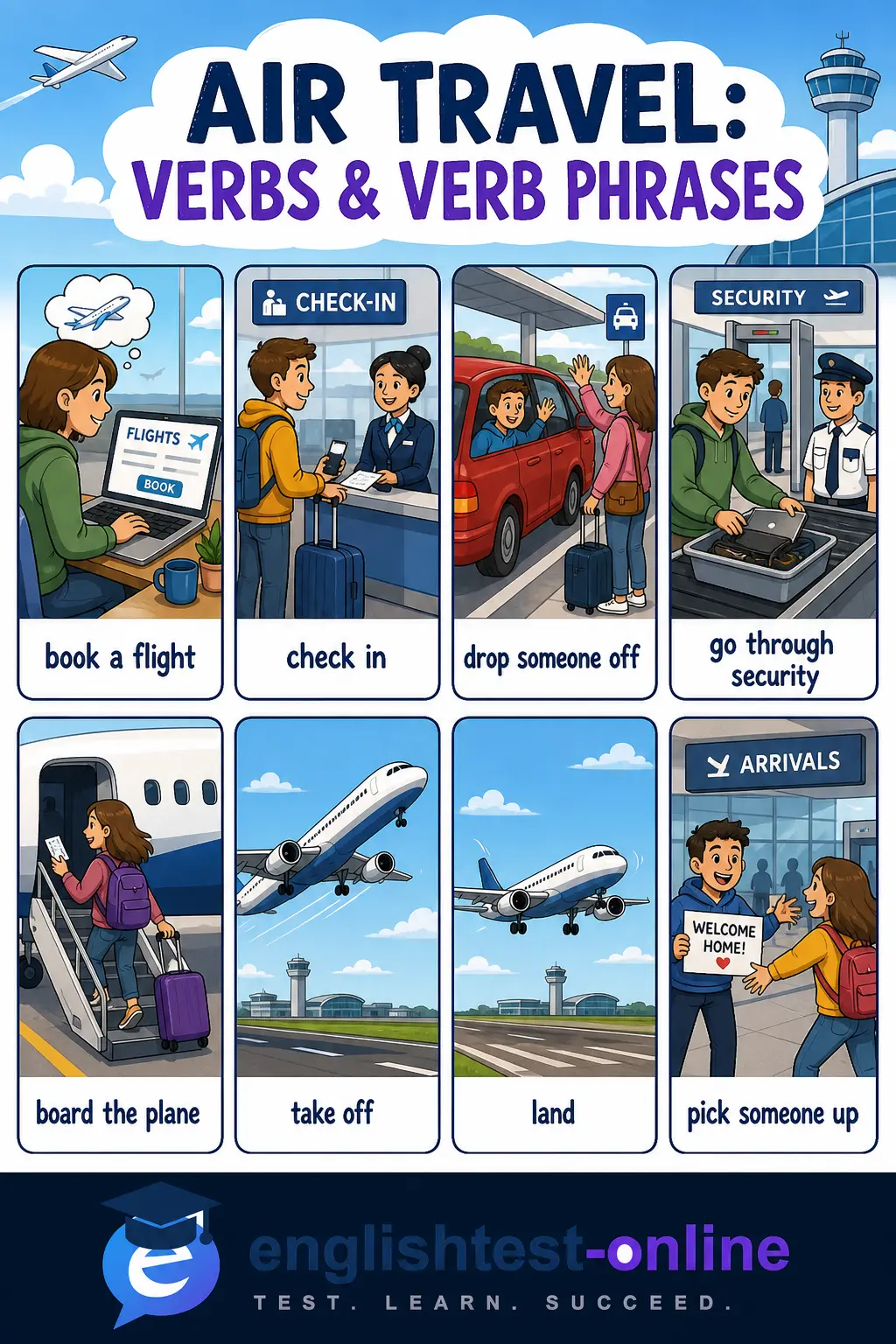
You normally book a flight before you travel. A direct flight takes you to your destination without changing planes, while a connecting flight requires a transfer at another airport. Before departure, passengers check in online or at the airport, receive a boarding pass and check in luggage that will travel in the aircraft's hold.
Someone may drop you off outside the terminal and pick you up after you arrive. Inside the airport, you go through security, clear passport control and eventually board the plane. A plane takes off when it leaves the ground and lands when it returns to the ground.
Delays, cancellations and connections
A flight that leaves later than planned is delayed. If it will not operate at all, it is cancelled. Passengers with a short layover may need to hurry to make their connection. If they arrive too late, they miss their connecting flight. An airline may then rebook them on a later service.
- Our flight was delayed by ninety minutes.
- We had a three-hour layover in Madrid.
- The airline rebooked us after the cancellation.
- We just managed to make our connection.
Air travel: at the airport
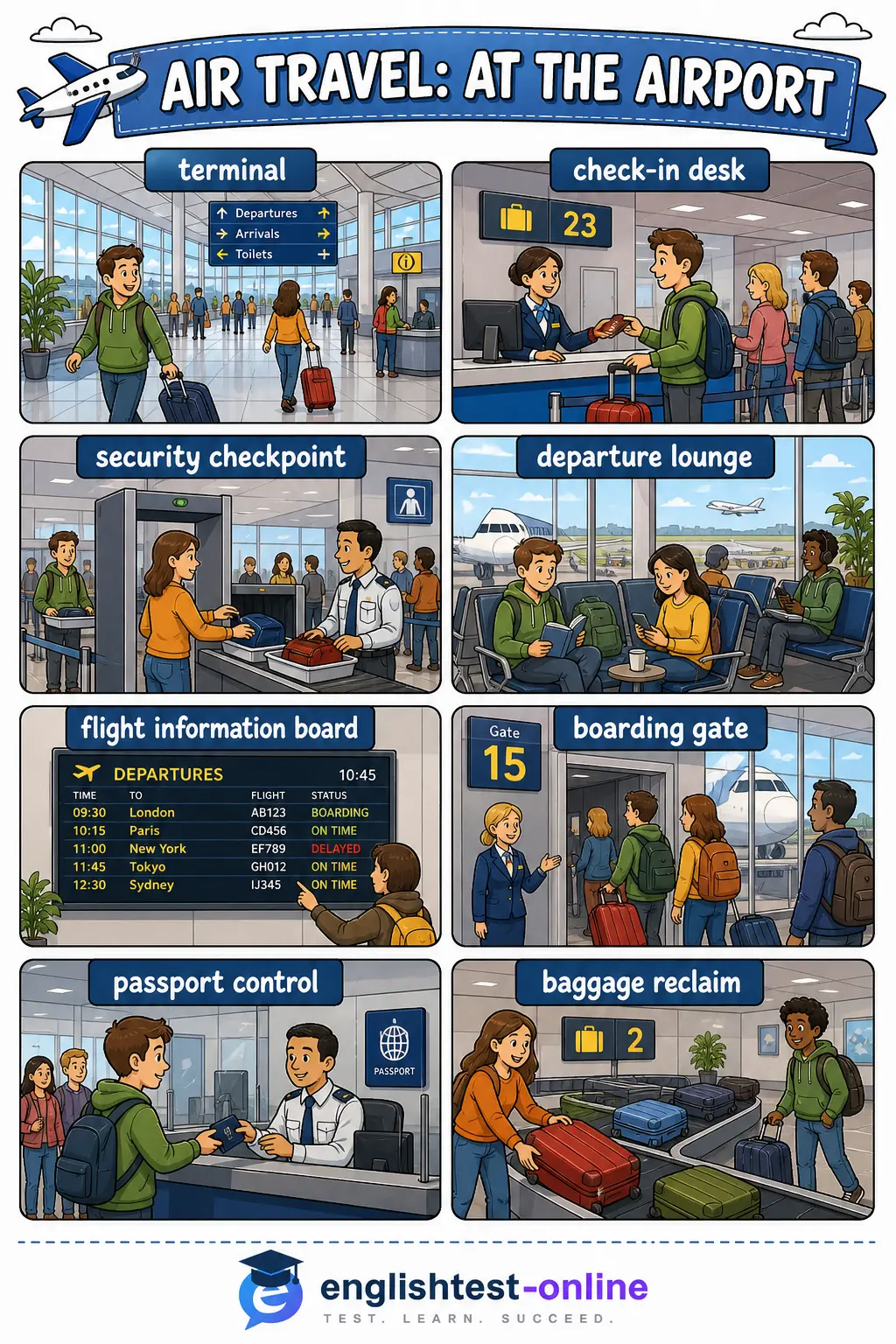
The terminal is the main airport building used by passengers. At the check-in desk, airline staff confirm your reservation, label checked bags and issue a boarding pass. At the security checkpoint, passengers and cabin bags are screened before they enter the airside area.
After security, travellers wait in the departure lounge. A flight information board displays destinations, flight numbers, departure times, gate numbers and status updates. When boarding begins, passengers go to the correct boarding gate and have their documents scanned.
International arrivals
For an international journey, officers at passport control inspect travel documents. After landing, passengers collect checked suitcases from the carousel in baggage reclaim (UK) or baggage claim (US). They may then pass through customs, where goods entering a country can be inspected.
If your suitcase does not arrive, go to the lost luggage desk and report it. Keep your baggage receipt because it helps staff identify the missing bag. Airport signs may also direct you to transfers, ground transportation, car rental and the arrivals hall.
Air travel: on the plane
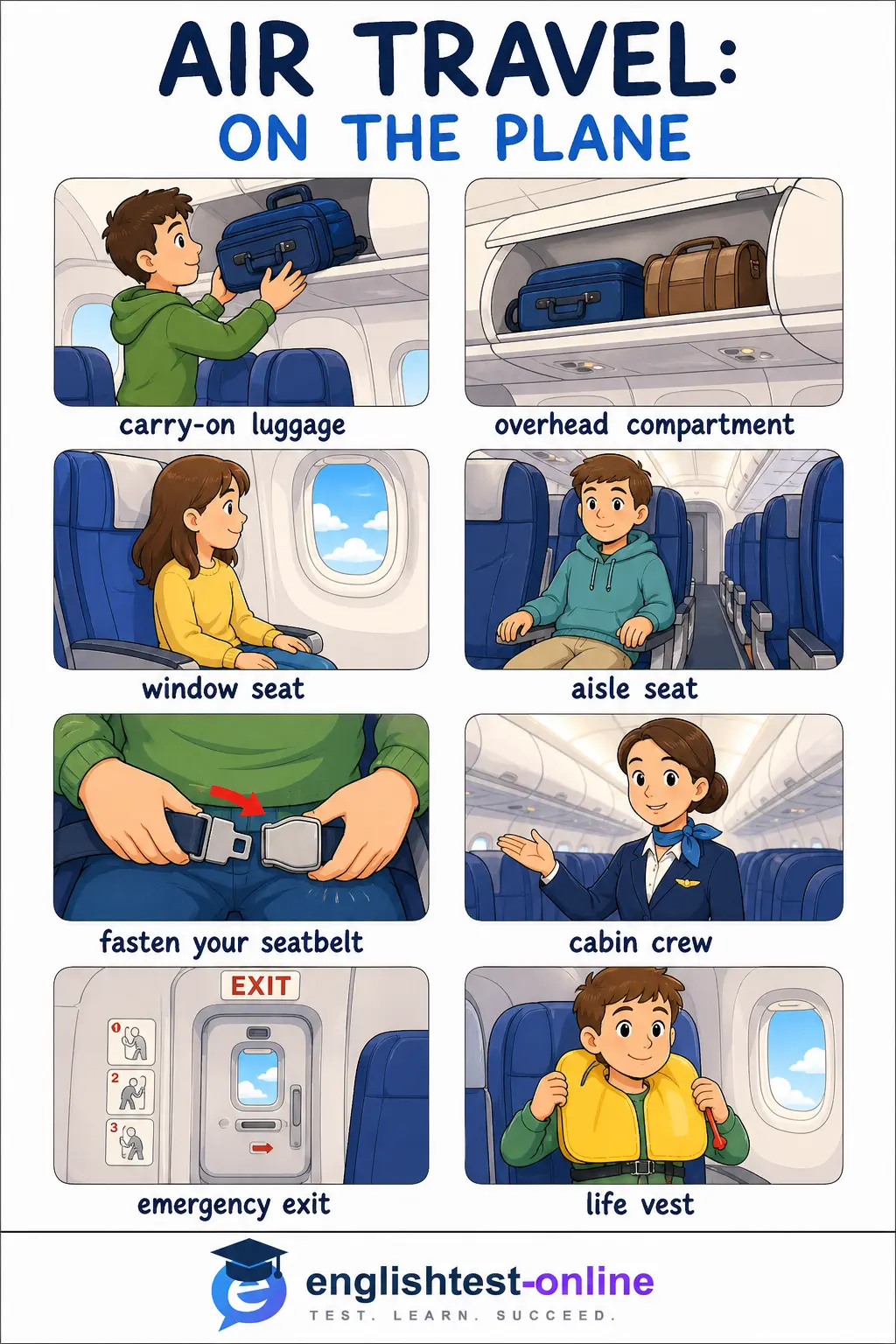
Small bags that remain with you are called carry-on luggage or hand luggage. They usually go in the overhead compartment or under the seat in front. A window seat is beside the window, an aisle seat is next to the aisle, and a middle seat is between two passengers.
Before take-off, the cabin crew ask passengers to fasten their seatbelts, put seat backs upright and stow bags safely. They demonstrate the location of the emergency exits, oxygen masks and life vests. The captain is the pilot in command of the aircraft, while flight attendants look after safety and passenger needs in the cabin.
During the flight
Turbulence is irregular movement caused by changing air currents. During turbulence, passengers should remain seated when instructed and keep their seatbelts fastened. A long-distance service may be called a long-haul flight; a shorter regional journey is a short-haul flight. The planned arrival time is often announced as the estimated time of arrival, or ETA.
Useful air travel collocations
- catch a flight, miss a flight, board a flight
- check in online, check in a suitcase, show a boarding pass
- go through security, clear passport control, declare goods
- make a connection, change planes, have a layover
- fasten a seatbelt, stow a bag, recline a seat
Common mistakes
- Luggage and baggage are uncountable: say two bags or two pieces of luggage, not two luggages.
- Passengers board a plane; a plane takes off.
- You arrive at an airport but arrive in a city or country.
- Say My flight was delayed, not My flight delayed.
- Customs checks goods; passport control checks travel documents.
Complete the three exercises to practise airport places, on-board equipment and the verb phrases used throughout an air journey.
Comments (0)
Log in to join the discussion.