
Crime and Punishment - B1+ English Vocabulary — Explanation
News reports, films and everyday discussions often use specialised language to describe how a crime is investigated and how a court reaches a decision. This B1+ vocabulary lesson explains essential crime and punishment vocabulary, including the people involved, types of evidence, courtroom procedures and possible outcomes.
From a reported crime to an arrest
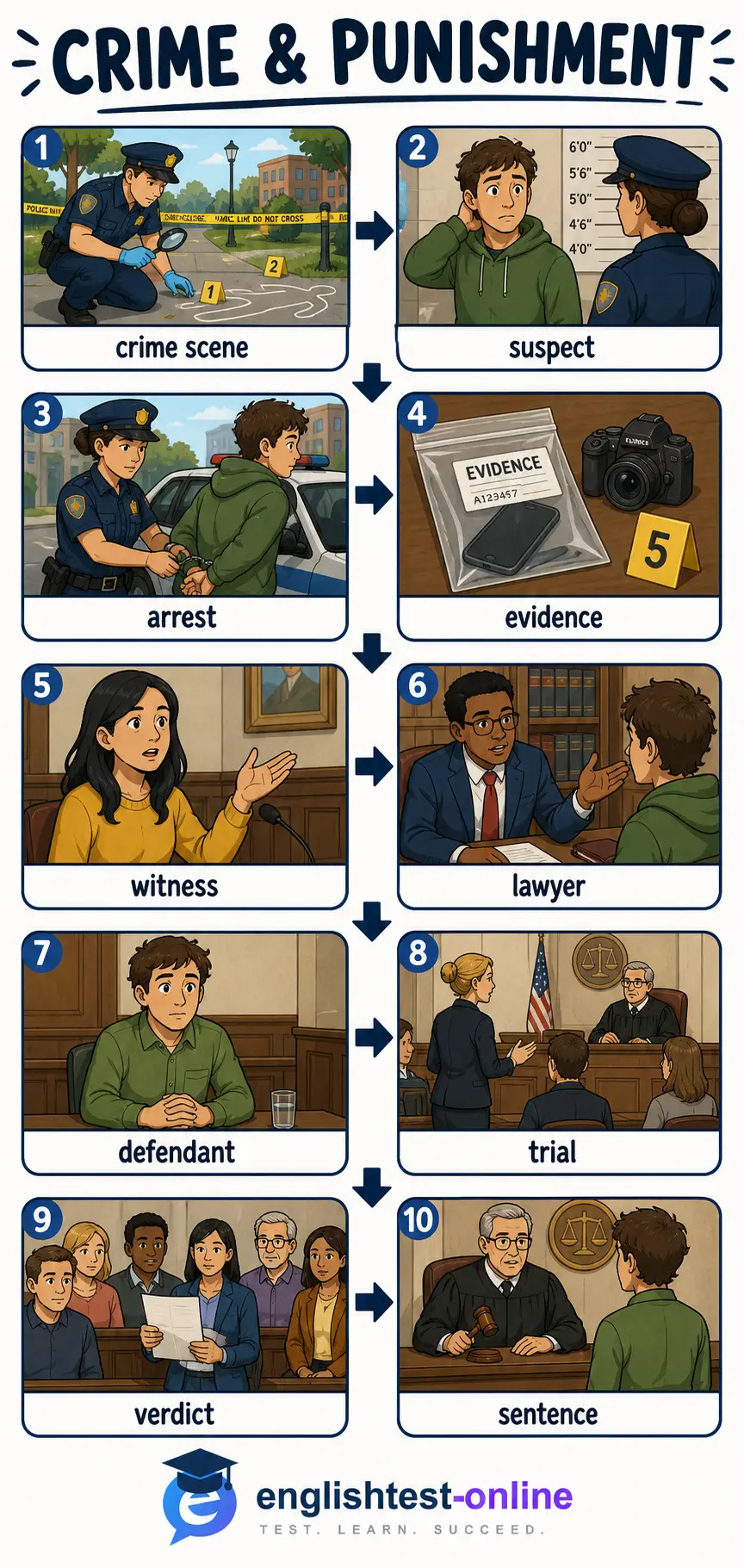
When an offence is reported, the police may examine the crime scene, interview people and collect evidence. Evidence is information or material that helps establish what happened. It can include security-camera recordings, documents, messages, DNA or fingerprints.
A person believed to be connected with an offence is a suspect. This word does not mean that the person has been proved guilty. Investigators may question or interview a suspect. If they have the necessary legal grounds, they may arrest the person and take them into custody.
Witnesses, victims and alibis
A witness is someone who saw an event or has relevant information. A victim is a person who suffered harm or loss because of an offence. Witnesses may give a statement to investigators and later give evidence in court.
An alibi is information showing that a suspect was somewhere else when the offence happened. Investigators check alibis and compare different accounts. Police may need a search warrant—official legal permission—before searching certain private places.
Charges and the people in court
To charge someone with an offence means to formally accuse them under the law. Once a case reaches court, the accused person is called the defendant. The defendant is represented by a defence lawyer, while the prosecution presents the case against them.
A judge manages the proceedings, applies the law and makes legal decisions. In some legal systems, a jury—a group of members of the public—listens to the case and decides whether the defendant is guilty. The exact roles of judges and juries vary between countries.
The trial and the verdict
A trial is the formal court process used to examine the evidence and arguments. Witnesses may testify, lawyers may question them, and documents or objects may be presented as evidence. A defendant is presumed innocent unless proved guilty according to the applicable legal standard.
The court's decision is the verdict. A guilty verdict means the court has concluded that the defendant committed the offence. If the defendant is acquitted, the court finds them not guilty of the charge. If a case is dismissed, it ends without a determination of guilt on that charge.
Punishment and sentencing
After a guilty verdict, the judge may impose a sentence. The verb is also sentence: The judge sentenced the offender to two years in prison. Possible penalties include a fine, community service, probation or a prison sentence. The available punishments depend on the offence and the legal system.
On probation, an offender remains in the community but must follow particular conditions. Community service requires unpaid work for the public benefit. A suspended sentence is not served immediately, provided that the offender obeys the conditions set by the court.
Essential crime and punishment collocations
- commit a crime, report an offence, investigate a case
- collect evidence, take fingerprints, obtain a warrant
- arrest a suspect, question a witness, give a statement
- charge someone with theft, stand trial, plead guilty/not guilty
- reach a verdict, find someone guilty, acquit the defendant
- impose a sentence, pay a fine, serve a prison sentence
Word families
- crime (noun), criminal (noun/adjective)
- accuse (verb), accused (noun/adjective), accusation (noun)
- defend (verb), defendant (person), defence (noun)
- prosecute (verb), prosecutor (person), prosecution (noun)
- convict (verb), conviction (noun), convicted (adjective)
Common mistakes
- Say charge someone with a crime, not charge someone of a crime.
- Say accuse someone of theft, not accuse someone with theft.
- Evidence is normally uncountable: say a piece of evidence, not an evidence.
- A suspect has not necessarily been charged; a defendant is formally accused in a court case.
- A verdict is the decision about guilt; a sentence is the punishment.
Complete the three exercises to practise legal roles, investigation vocabulary, court procedures and punishment collocations in clear B1+ contexts.
Comments (0)
Log in to join the discussion.