
Clothes - B1+ English Vocabulary — Explanation
Talking confidently about clothing involves more than knowing the names of garments. This B1+ lesson develops practical clothes vocabulary in English for describing style, fit, patterns and materials, as well as the verbs we use when choosing, wearing and caring for clothes.
Clothing style
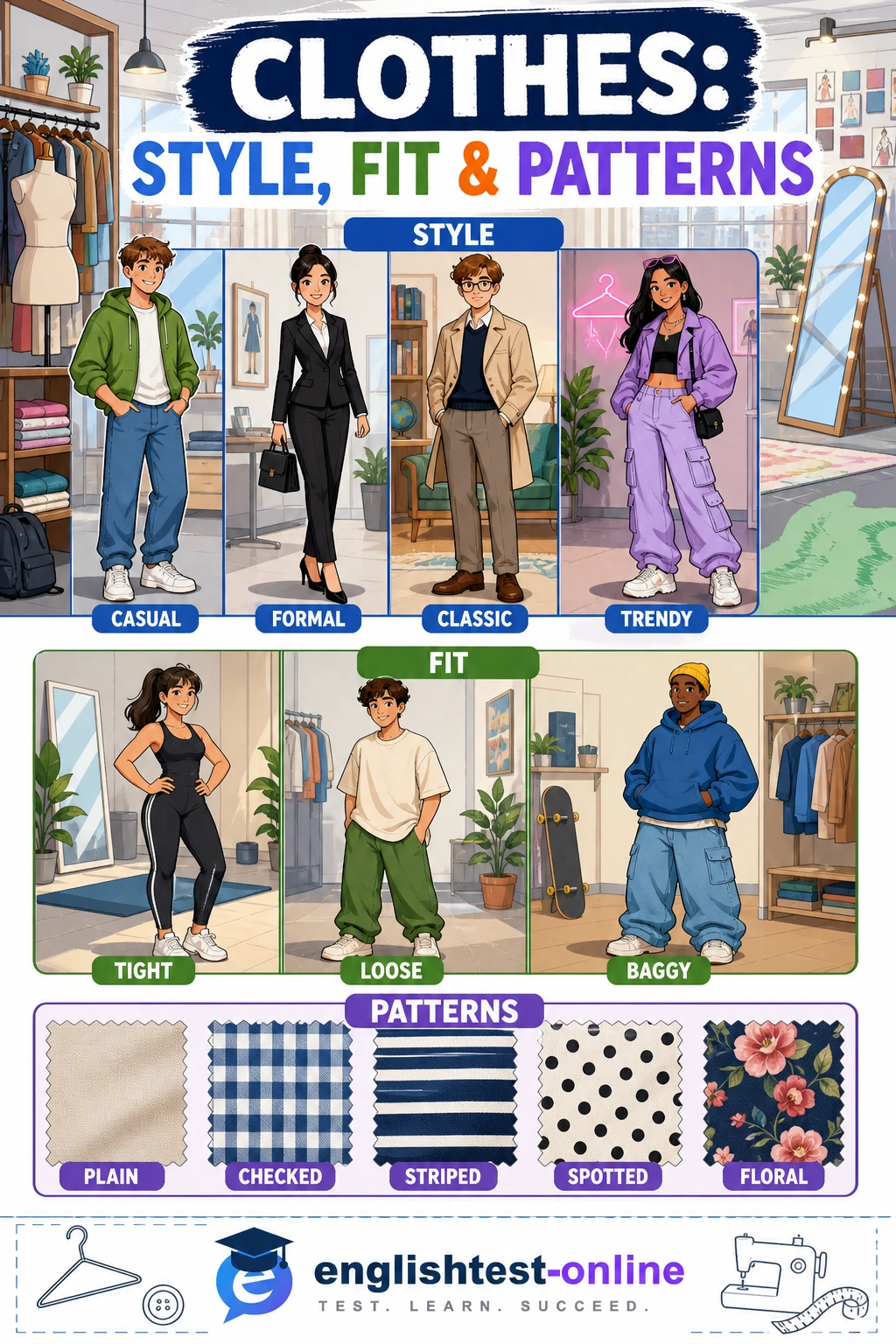
Trendy clothes follow a fashion that is popular right now, while fashionable has a broader meaning and describes something accepted as attractive or in fashion. Stylish focuses on looking attractive and well put together, even when an outfit does not follow the latest trend. Chic suggests simple, sophisticated elegance.
- Her trainers are trendy this season, but her long coat has a classic design.
- He combines simple colours to create a stylish outfit.
- The restaurant is smart, so choose something chic rather than sportswear.
Casual clothes are relaxed and suitable for ordinary situations. Formal clothes are worn at ceremonies, important meetings and other serious occasions. Classic designs remain attractive for a long time instead of changing with every season. Comfortable describes how pleasant something feels, not how fashionable it is.
Fit: tight, loose and baggy
Clothes that are tight fit very close to the body and may restrict movement. Loose clothes leave extra space and usually feel relaxed. Baggy clothes are noticeably larger than the wearer's body and often form part of a deliberate style. If a garment fits, it is the correct size and shape for you.
Remember the difference between fit and suit: a jacket can fit because it is the right size but not suit you because its colour or style is unflattering.
Patterns and designs
A plain item has no decorative pattern. Striped fabric has parallel lines, while checked fabric has a regular arrangement of squares. Spotted or polka-dot clothing is covered with dots. Floral material displays flowers, and patterned is the useful general adjective for fabric with a repeated design.
Common clothing materials
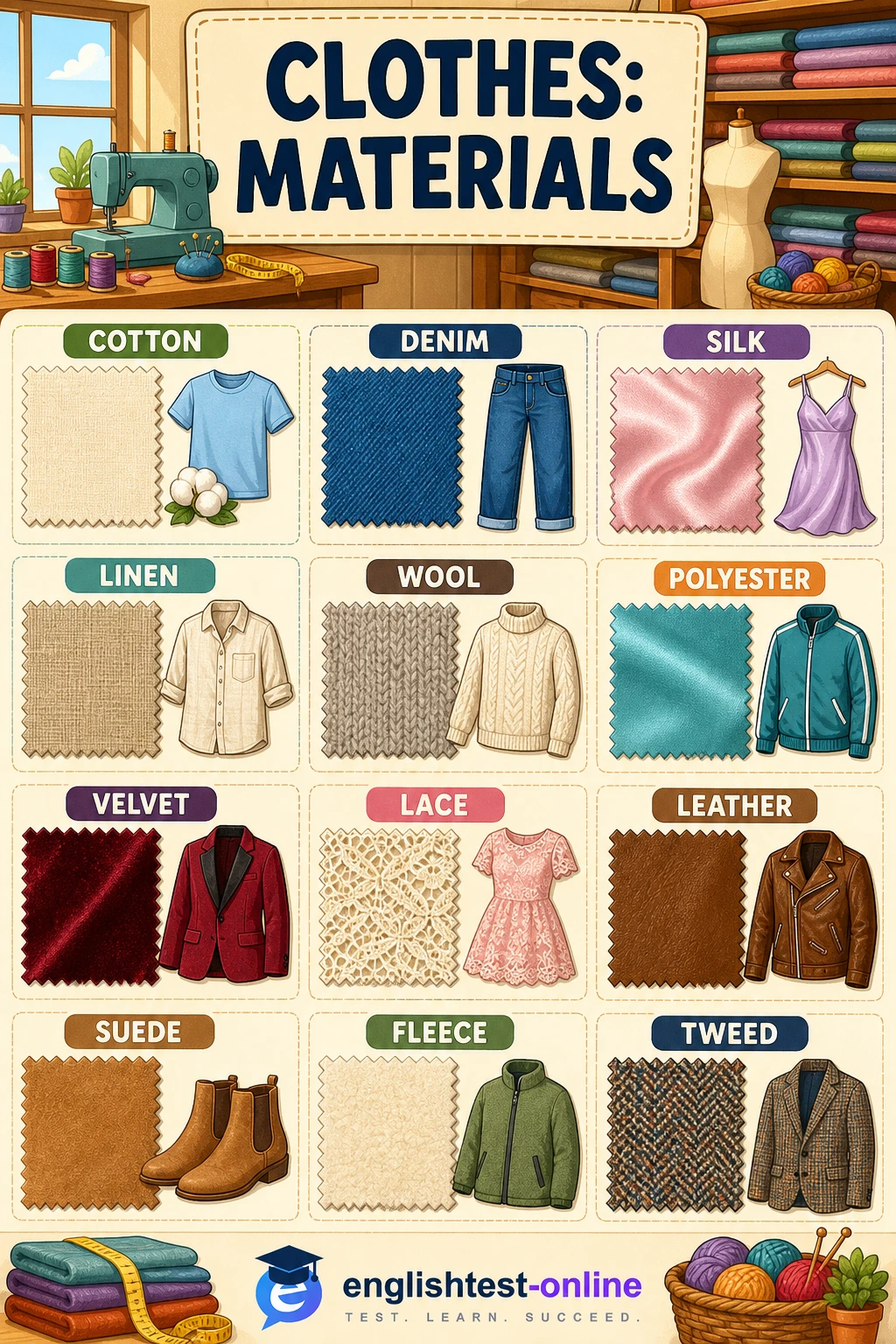
Cotton is a soft, breathable natural fibre used for T-shirts, shirts and underwear. Linen is light and cool, making it popular for summer clothing, although it creases easily. Wool provides warmth and is often used for jumpers, coats and scarves.
Denim is the strong cotton fabric associated with jeans and casual jackets. Silk is smooth, light and often shiny, while velvet has a thick, soft surface. Lace is delicate, decorative material with an open pattern of holes.
Polyester is a hard-wearing synthetic fibre that dries quickly and resists creasing. Fleece is a soft synthetic fabric commonly used for warm outdoor tops. Tweed is a thick, rough woollen material traditionally used for jackets and coats.
Leather is a strong, flexible material used for jackets, belts, bags and shoes. Suede is leather with a softer, brushed surface. Synthetic alternatives are also widely available, so expressions such as faux leather and faux fur are useful when describing non-animal materials.
Use made of when the material remains recognisable: The belt is made of leather. Use a material as an adjective before the garment: a cotton shirt, denim jeans and a silk scarf.
Verbs and phrasal verbs for clothes
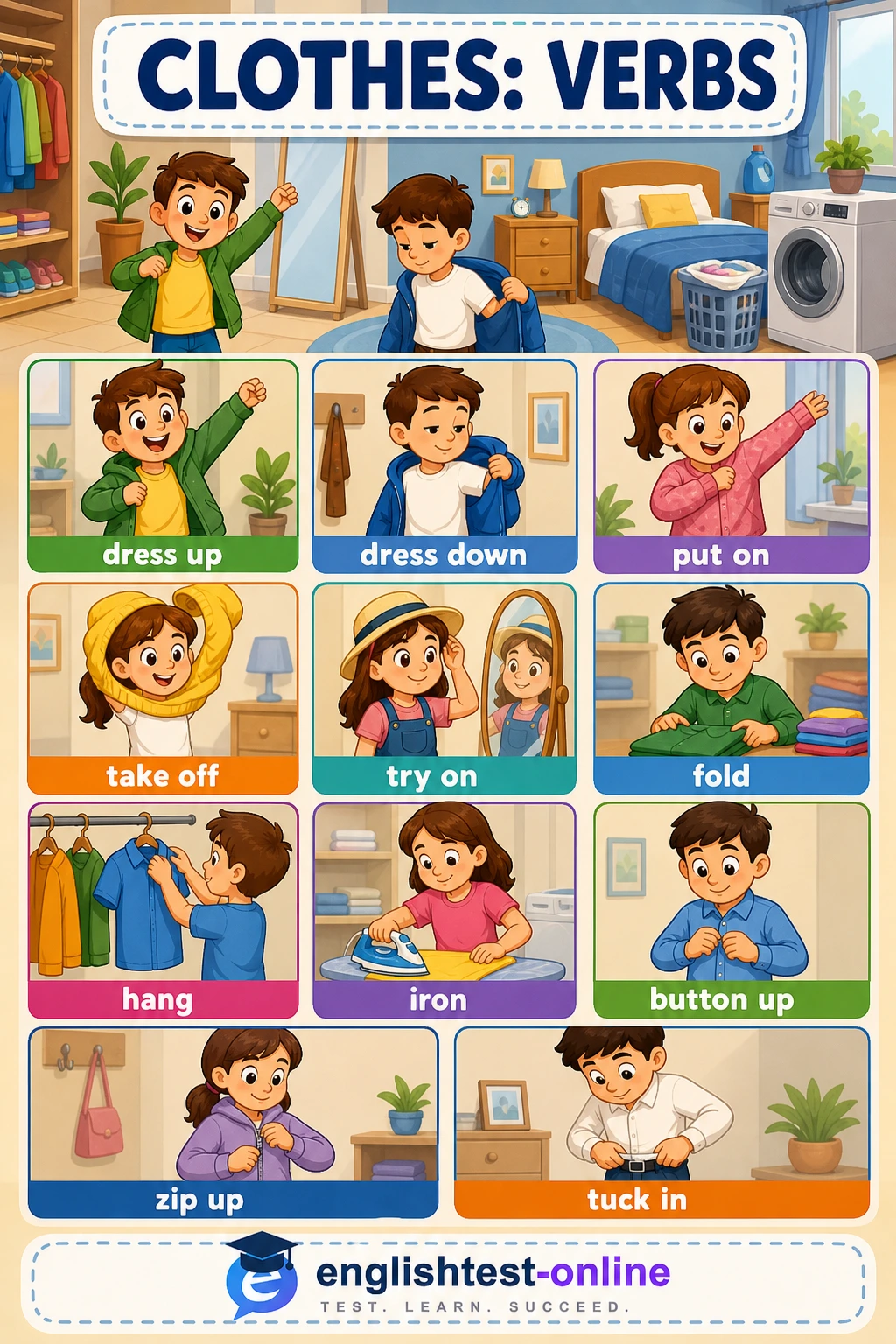
To put on clothes is to place them on your body; to take them off is to remove them. To try on an item means to wear it briefly to check its size or appearance before buying it. With pronouns, the pronoun goes in the middle: put it on, take them off and try it on.
When you dress up, you wear smarter or more special clothes than usual, or you wear a costume. To dress down means to choose a more casual outfit. To get dressed means to put on all the clothes you need, while wear describes having clothes on your body.
Fit, suit and match express different ideas. Clothes fit when their size is right. A style or colour suits a person when it makes them look good. Two items match when they look good together or have the same colour or pattern.
Clothing-care verbs include fold, hang and iron. You fold a T-shirt before putting it in a drawer, hang a coat on a hanger and iron a shirt to remove creases. You can also button up a shirt, unbutton it, zip up a jacket, unzip it and tuck in the bottom of a shirt.
Useful clothes collocations
- wear an outfit, a uniform, jewellery or a pair of shoes
- get dressed for work; change into comfortable clothes
- go with or match another item
- be made of cotton; a leather jacket
- come into fashion and go out of fashion
- do up or undo buttons, laces and zips
Common mistakes
- Say These trousers fit me for size, but That colour suits you for appearance.
- Say It is made of cotton, not made from cotton, when the material is still identifiable.
- Clothes is always plural: My clothes are clean. A single object is an item/piece of clothing.
- Wear describes a state; put on describes an action: She is wearing a coat because she put it on earlier.
- Use plural verbs with jeans, shorts and trousers: These jeans are loose.
Complete the three exercises to practise clothes vocabulary for style, fit, patterns, materials and everyday actions.
Comments (0)
Log in to join the discussion.