
Personality - B1+ English Vocabulary — Explanation
Describing personality accurately helps you talk about friends, colleagues, characters and yourself. This B1+ lesson presents useful personality adjectives in English, with meanings, natural examples, common contrasts and grammar patterns.
Positive personality traits
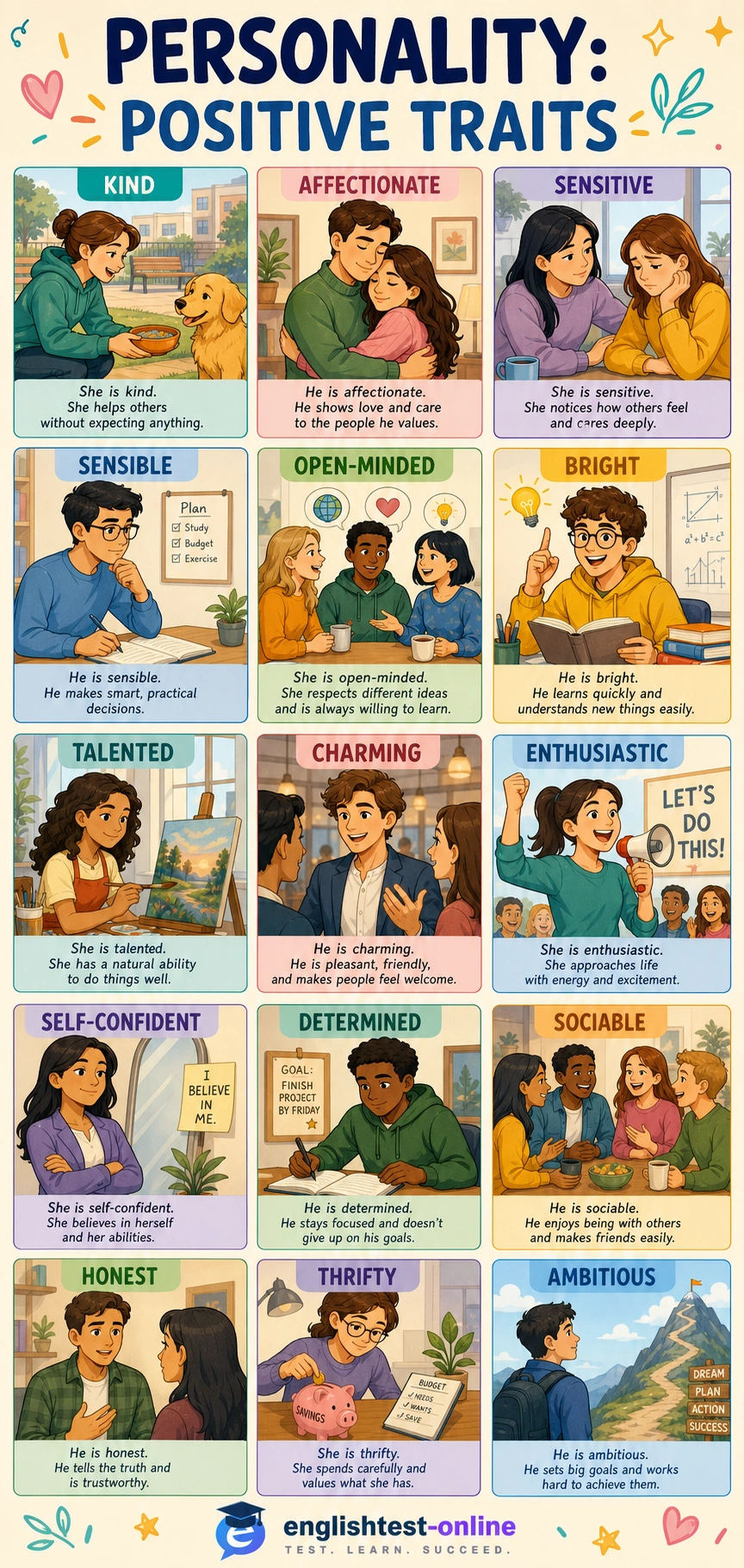
A kind person cares about others and behaves helpfully. Someone warm or affectionate expresses friendly feelings and love openly. A sensitive person notices emotions easily; this can mean understanding other people's feelings or becoming upset quickly, depending on context.
- Our new neighbour is warm and always makes visitors feel welcome.
- Jade was sensitive enough to notice that her colleague needed support.
Sensible means practical and able to make good decisions. A down-to-earth person is realistic, approachable and not impressed by status. Someone open-minded is willing to consider unfamiliar ideas and different opinions.
A bright person learns and understands quickly, while a talented person has a particular natural ability. Creative people produce original ideas. A charming person has a pleasant manner that attracts others.
An enthusiastic person shows energy and excitement. Someone determined continues working towards a goal despite difficulty, and an ambitious person strongly wants achievement or success. Self-confident people trust their own abilities without necessarily believing they are better than others.
Sociable and outgoing describe people who enjoy meeting and talking to others. Honest means truthful, while sincere suggests that a person's words and feelings are genuine. A thrifty person uses money and resources carefully rather than wasting them.
Negative and neutral personality traits
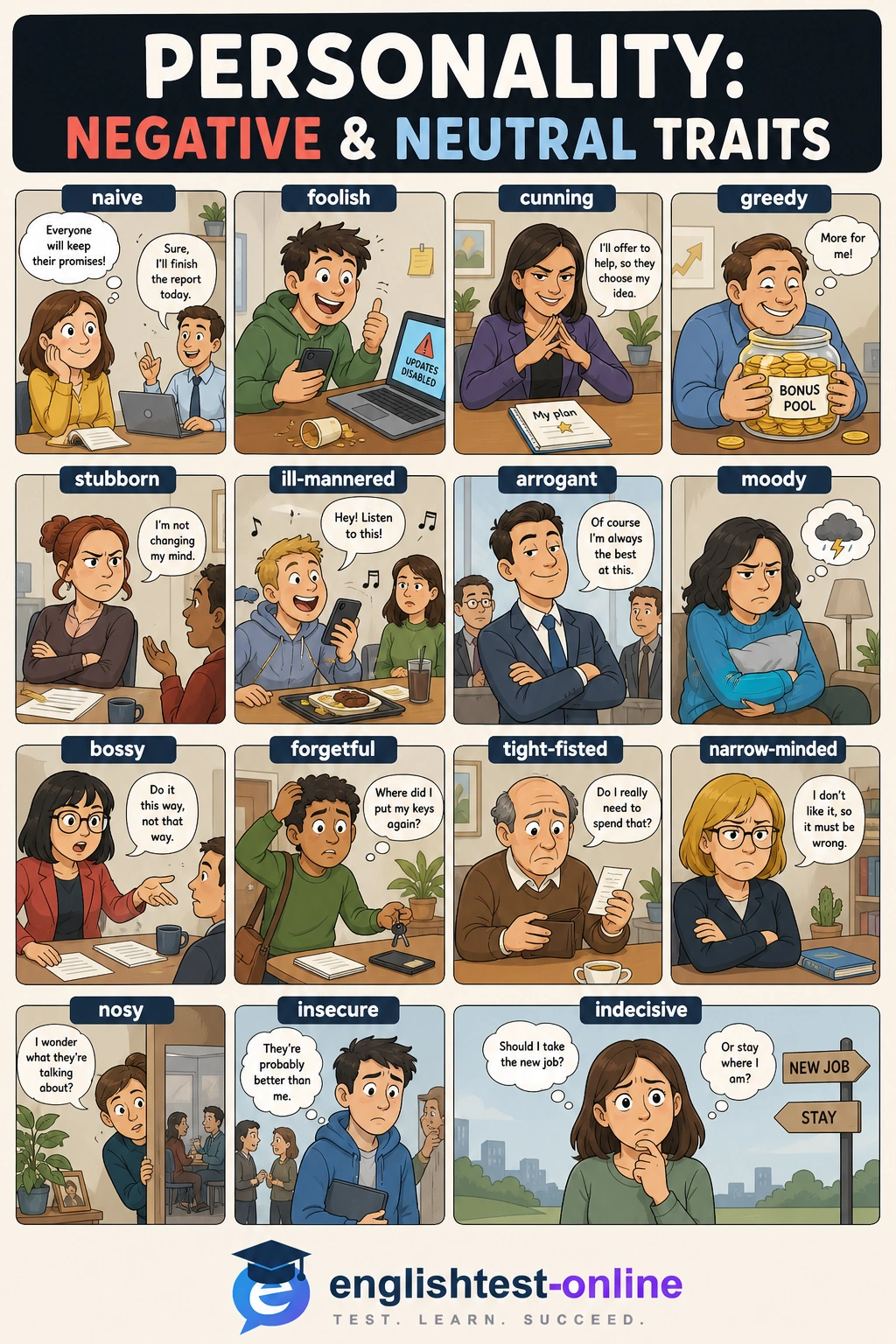
A naive person trusts others too easily because they lack experience. Foolish describes behaviour that shows poor judgement. These words should be used carefully because personality labels can sound critical; it is often kinder and more precise to describe a particular action.
Cunning means clever at achieving an aim, often through secrecy or deception. A greedy person always wants more money, food, power or possessions. Someone tight-fisted strongly dislikes spending money; unlike thrifty, this normally has a negative meaning.
A stubborn person refuses to change an opinion even when there are good reasons to do so. Narrow-minded people are unwilling to consider different beliefs or ways of life. The positive contrast is open-minded.
Ill-mannered means rude and lacking good manners. An arrogant person behaves as if they are more important or capable than everyone else. Someone bossy keeps telling other people what to do, whereas an effective leader listens and gives clear, respectful direction.
A moody person experiences frequent changes in mood. A forgetful person often fails to remember things. Someone nosy asks too many questions about private matters. An insecure person lacks confidence, and an indecisive person has difficulty making choices.
Some adjectives depend strongly on perspective. Quiet, serious, reserved and competitive can be neutral, positive or negative according to the situation and the speaker's attitude.
Important contrasts
- self-confident = trusting your abilities; arrogant = believing you are superior
- determined = continuing towards a useful goal; stubborn = refusing to reconsider
- thrifty = avoiding waste; tight-fisted = unwilling to spend even when appropriate
- curious = wanting to learn; nosy = interfering in private matters
- innocent = inexperienced or not guilty; naive = too ready to believe people
- sensitive = aware of feelings; insecure = uncertain about your value or ability
Grammar for describing personality
Use be + adjective for a general trait: Leo is patient. Use behave in a/an + adjective + way for behaviour in one situation: He behaved in a selfish way. The pattern It is + adjective + of someone + to-infinitive evaluates an action: It was generous of you to help.
Adjectives can be softened with quite, rather, a little or a bit: She can be a bit bossy. Add sometimes or tends to be when the behaviour is not permanent. This often sounds fairer than giving someone a fixed negative label.
Word families and collocations
- honest – honesty; confident – confidence
- ambitious – ambition; determined – determination
- sensitive – sensitivity; generous – generosity
- show enthusiasm, have a talent for, make a sensible decision
- remain open-minded, sound arrogant, become impatient
- deeply insecure, extremely stubborn, naturally sociable
Common mistakes
- Personality describes character; appearance describes how someone looks.
- Say She is good at languages or She has a talent for languages.
- Sensible means practical; sensitive relates to feelings.
- Sympathetic means understanding someone's problems, not friendly or likeable.
- Use hyphens in adjectives such as open-minded, self-confident, down-to-earth and tight-fisted.
Complete the three exercises to practise positive, neutral and negative personality adjectives in realistic B1+ situations.
Comments (0)
Log in to join the discussion.